Speech activity and pitch
Two questions come before almost anything else I do with a speech recording:
where in it somebody is talking, and what pitch they are on.
vad (voice activity detection) and its relatives
answer the first, with nothing beyond numpy. f0
answers the second: it tracks the fundamental frequency with librosa's pYIN
(probabilistic YIN) and keeps the voiced/unvoiced decision next to the pitch.
| To | Use |
|---|---|
find where somebody is talking, as (start, end) in seconds |
vad |
| cut each stretch of speech out as its own clip | vad_split |
| drop everything before the first word and after the last | vad_trim |
| find the recordings in a folder with no speech in them | speech_ratio |
| mark each spectrogram frame as speech or not | vad_frames |
| track the pitch, and where there is one | f0, which returns a PitchTrack |
| open either result in an editor | Label, save_labels |
Every example below runs on one synthetic recording. Run the code in the box once, in an empty folder. The blocks after it continue from there, with numpy and kudio imported and the three files in place, and print what the page shows.
The recording used on this page
Three voiced words with a gliding pitch, an /s/ running into the second
one, and a loud broadband clatter that is not speech. quiet.wav puts them
in a quiet room, fan.wav in front of a fan, and empty.wav holds the
clatter and the fan with nobody talking.
import numpy as np
import kudio

sr = 16000
n = 6 * sr
rng = np.random.default_rng(7)

def at(start, x):                      # place x at `start` seconds
    out = np.zeros(n)
    out[int(start * sr):int(start * sr) + len(x)] = x
    return out

def vowel(seconds, f_from, f_to, level=1.0):   # harmonics of a gliding f0
    m = int(seconds * sr)
    phase = 2 * np.pi * np.cumsum(np.linspace(f_from, f_to, m)) / sr
    tone = sum(np.sin(k * phase) / k for k in range(1, 16))
    return 0.08 * level * tone * np.sin(np.pi * np.arange(m) / m) ** 0.5

def hiss(seconds, level, cutoff=None):         # a noise burst
    m = int(seconds * sr)
    x = rng.standard_normal(m)
    if cutoff:
        x = kudio.highpass(x, sr, cutoff=cutoff)
    return level * x * np.hanning(m)

voice = (at(0.8, vowel(0.8, 140, 110))
         + at(3.0, hiss(0.15, 0.05, cutoff=3500))      # an /s/ ...
         + at(3.12, vowel(0.85, 120, 165))             # ... running into a vowel
         + at(4.6, vowel(0.8, 130, 100, level=0.5)))   # a quieter last word
clatter = at(2.2, hiss(0.25, 0.25))                    # loud, broadband, not speech
room = 0.0005 * rng.standard_normal(n)                 # a quiet room
fan = 0.03 * kudio.lowpass(rng.standard_normal(n), sr, cutoff=1000)

kudio.save_wave("quiet.wav", voice + clatter + room, sr)
kudio.save_wave("fan.wav", voice + clatter + fan, sr)
kudio.save_wave("empty.wav", clatter + fan, sr)       # nobody talking
Why a silence threshold is not enough
split_on_silence and
trim_silence (see
Editing and effects) decide on level alone: a frame is silence
when it sits more than top_db under the loudest frame of the file, 30 dB by
default. Here is the same voice in both rooms:
for name in ("quiet.wav", "fan.wav"):
    y, sr = kudio.file_load(name)
    for top_db in (30, 25, 20):
        parts = kudio.split_on_silence(y, top_db=top_db)
        print(f"{name:9}  top_db={top_db}  ", [round(len(p) / sr, 2) for p in parts])
quiet.wav  top_db=30   [0.9, 0.32, 1.02, 0.83]
quiet.wav  top_db=25   [0.83, 0.32, 0.99, 0.77]
quiet.wav  top_db=20   [0.77, 0.29, 0.93, 0.61]
fan.wav    top_db=30   [6.0]
fan.wav    top_db=25   [0.9, 0.32, 1.02, 0.83]
fan.wav    top_db=20   [0.8, 0.29, 0.96, 0.64]
In the quiet room the default finds four parts. In front of the fan it finds
one, six seconds long: the whole file. The fan sits about 26 dB under the
loudest frame, so at top_db=30 it counts as sound. top_db=25 happens to
rescue this file, but the right number depends on how loud this fan is next
to the loudest moment of this take, and that moment is the clatter, not the
voice. Going lower to be safe eats into the words: at 20 the quiet last word
is down from 0.83 s to 0.64 s behind the fan, and to 0.61 s in the quiet
room. And wherever the file splits at all, the second part is the clatter,
because loud is all split_on_silence asks.
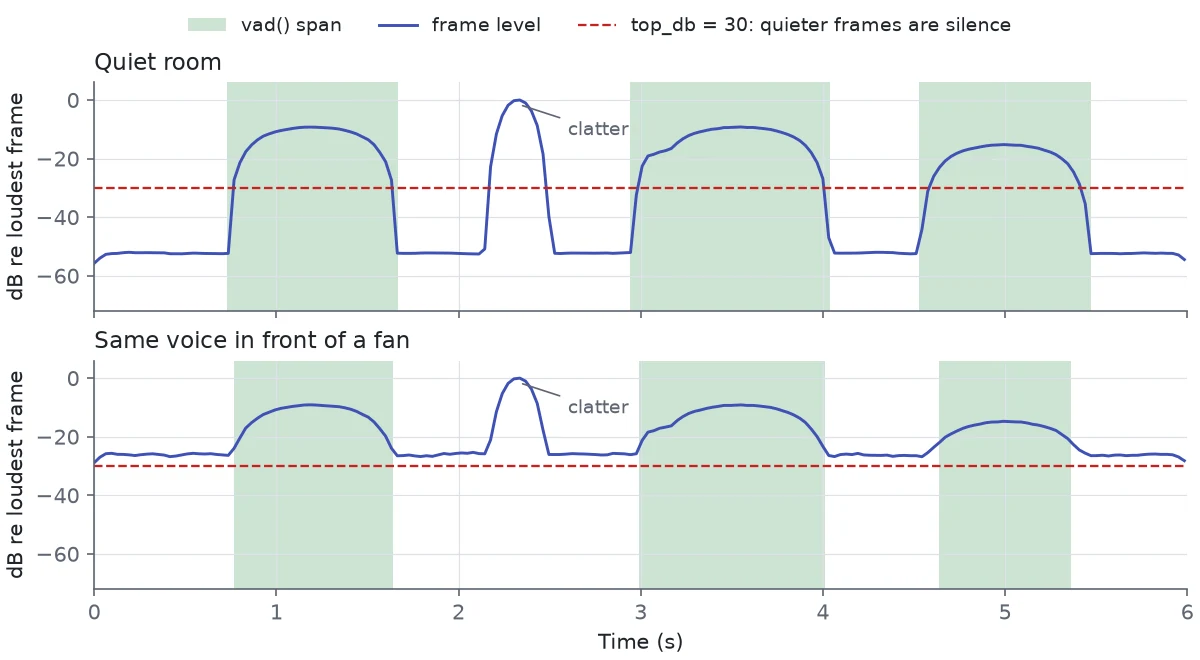
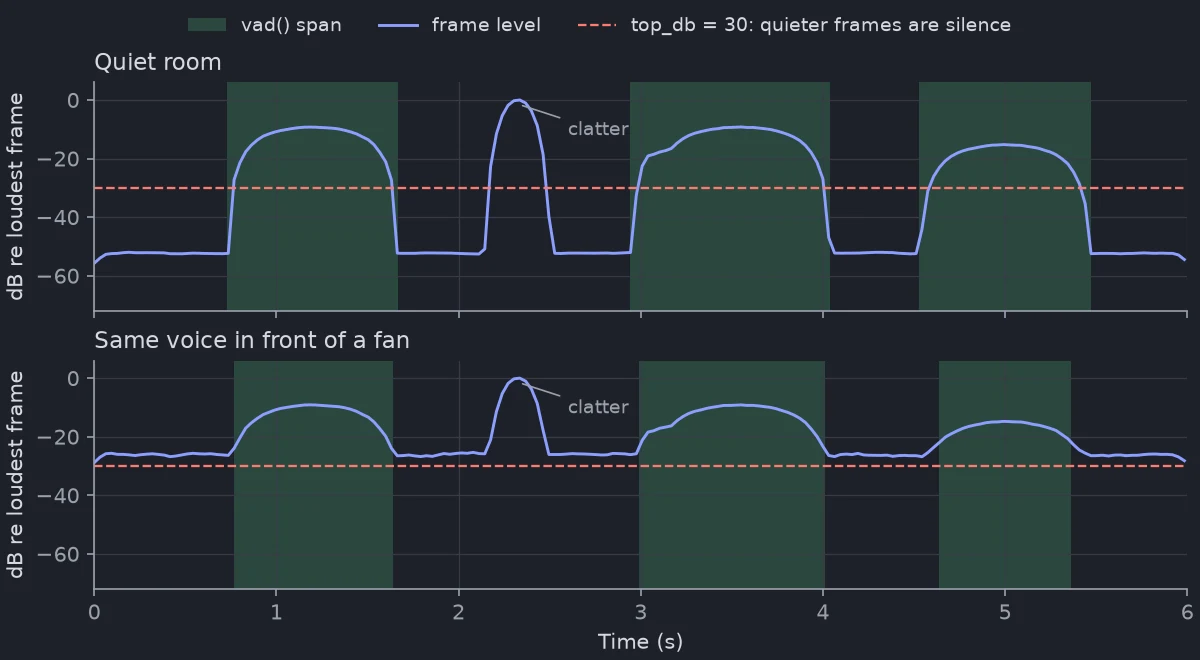
This is the level split_on_silence measures, each frame against the loudest
one. Behind the fan nothing drops under the dashed top_db line. The shaded
spans are what vad finds, with the same settings in
both rooms:
for name in ("quiet.wav", "fan.wav"):
    y, sr = kudio.file_load(name)
    print(f"{name:9}", [(round(a, 2), round(b, 2)) for a, b in kudio.vad(y, sr)])
quiet.wav [(0.73, 1.67), (2.94, 4.04), (4.53, 5.47)]
fan.wav   [(0.77, 1.64), (2.99, 4.01), (4.64, 5.36)]
Three spans in each room, no clatter, nothing tuned between the two runs. The
result is (start, end) pairs in seconds, and an empty list when nothing
looks like speech. Behind the fan the last word comes out shorter, 4.64 to
5.36 s against 4.53 to 5.47 s: its onset and decay are too close to the fan's
level for the 8 dB test described below.
threshold_db=6 brings it back to 4.61 to 5.40 s with no new span; at 5 the
clatter comes back too, as 2.17 to 2.50 s.
split_on_silence is still the tool for something that is not speech in a
quiet room, such as a knock. For speech, use vad.
Cutting, trimming and counting
vad_split returns the spans as waveforms,
vad_trim keeps everything from the first speech
to the last, and speech_ratio says how much
of the clip is speech. All three take the same keyword arguments as vad.
y, sr = kudio.file_load("fan.wav")

for n, part in enumerate(kudio.vad_split(y, sr), 1):
    kudio.save_wave(f"spans/fan_{n:03d}.wav", part, sr)

clip, (start, end) = kudio.vad_trim(y, sr)
print(start, end, round(len(clip) / sr, 2))
vad_trim returns (clip, (start, end)) in samples, the same shape as
trim_silence, so the code that uses
the result works with either. When it finds no speech it returns the clip
untouched with its full span, (0, 96000) for empty.wav, and logs that at
INFO. Deleting the audio is never the safer reading of "nothing found".
speech_ratio is the check I run over a folder of recordings before it
becomes training data:
from pathlib import Path

for path in sorted(Path(".").glob("*.wav")):
    y, sr = kudio.file_load(path)
    print(f"{path.name:10} {kudio.speech_ratio(y, sr):4.0%}")
empty.wav holds a clatter louder than any word in the other two and still
reads 0 %. A whole recording near zero in a folder that should be speech is a
recording of a room, and it should not reach a
noisy dataset as a clean target.
It needs some background in the file to measure against. vad takes its
noise floor from the file itself, so in a clip that is speech from end to end
the floor is the speech: the three files vad_split wrote above read 0 %,
35 % and 0 %. Run it on whole recordings, not on clips already cut to the
words.
From a shell, kudio vad fan.wav --split-to spans/ prints the same spans,
writes each to its own file, and exits 1 when there is no speech; see
Command line.
One decision per spectrogram frame
A model trained on spectrogram frames (see STFT and features),
or a noise estimate taken from the frames where nobody talks (see
Denoising), needs the decision per frame rather than per
span. vad_frames gives one boolean per STFT
frame, True where the frame's centre falls inside a span:
y, sr = kudio.file_load("fan.wav")
spec = kudio.waveform_to_spectrogram(y)        # (frames, bins), hop 256
speech = kudio.vad_frames(y, sr)               # (frames,), the same frames
print(spec.shape, speech.shape, speech.sum())

background = np.median(spec[~speech], axis=0)  # per bin, over what vad turned down
At its defaults it gives the frames of
waveform_to_spectrogram and
STFT at theirs. If you change hop_length, n_fft
or center there, pass the same values here.
Not speech is not the same as background. ~speech is everything vad
turned down, and in fan.wav that includes the clatter: 18 of the 232 frames
overlap it. Leaving those 18 out moves a mean over the frames by 3.5 to 4.6 dB
above 2 kHz, where the fan is weak, and the median by 1.1 dB at most, which is
why the example takes the median.
How vad decides
vad looks at 30 ms frames every 10 ms
(FRAME). A frame first has to be loud for this
file: the noise floor is the 15th percentile of the frame levels, and the
frame must sit THRESHOLD_DB (8 dB) above it.
A fan that runs through the whole recording is that floor, which is why
fan.wav needed nothing changed. Anything more than
FLOOR_REL_DB (45 dB) under the loudest frame
is never speech, so a near-silent file does not get its own hiss promoted.
A loud frame then has to look like a voice. Spectral flatness, the geometric
over the arithmetic mean of the frame's power spectrum, is under 0.001 for the
vowels here. The textbook value for white noise is 1.0, but one 30 ms frame of
it measures 0.46 to 0.66, 0.56 on average, and the clatter 0.53 to 0.61.
Under FLATNESS_MAX (0.40) a loud frame counts
by itself, and this is the test the clatter failed.
A loud frame that fails it still counts when its zero-crossing rate is above
ZCR_MIN (0.25: a quarter of neighbouring samples
change sign, as in a 2 kHz sine at 16 kHz) and a frame that passed lies
within FRICATIVE_REACH (0.2 s).
Zero-crossing rate cannot tell a broadband fricative from a burst of hiss;
standing next to a vowel can. The /s/ in this recording does not need the
rule: it is band-limited, its flatness is 0.045, and it passes on its own.
Last, gaps up to min_silence are bridged, since a stop consonant is a real
silence inside a word, spans shorter than min_speech are dropped, and pad
is added to each end.
| Argument | Default | Change it when |
|---|---|---|
threshold_db |
8.0 dB | a quiet talker is missed (lower it), or a noisy room leaks in (raise it) |
flatness_max |
0.40 | the audio is not speech (1.0 switches the test off) |
min_speech |
0.10 s | clicks and knocks come through as short spans (raise it) |
min_silence |
0.15 s | words split at their stops (raise it), or separate phrases merge (lower it) |
pad |
0.05 s | the cuts clip the first or last consonant (raise it) |
White noise sits close above the default flatness limit, so raise it with
care: on quiet.wav, 0.5 still finds the three words alone, and 0.6 brings
the clatter back as 2.14 to 2.51 s. The reference has
every argument. vad raises FeatureError
on a multichannel array; file_load mixes down to
mono unless you pass mono=False.
Where it goes wrong
I tried it on synthetic audio like the recording above, and these are the cases to know about before a corpus finds them.
Coloured noise that starts partway through a file is taken for speech. Noise
becomes the floor only when it covers about 85 % of the file or more. In a
four-second quiet recording, a fan switched on at 0.6 s was ignored; switched
on at 0.7 s it was reported as speech from 0.63 s to the end, and at 2 s from
1.93 s. Cut the file where the background changes and run vad on each part.
Flatness is measured over the whole spectrum, and noise that fills only part of it is uneven too. Alone in a quiet room, a 0.5 s rumble below 500 Hz and a 0.15 s hiss above 3.5 kHz were both reported as speech. Only noise spread across the whole band fails the flatness test, which is also why white noise switched on at 2 s was not reported.
Broadband noise right next to a word is joined to it, which is the consonant rule doing its job: a burst of white noise that ended where a vowel began became part of the vowel's span. With 0.4 s between them, it was dropped.
Pitch with f0
f0 runs pYIN (Mauch & Dixon 2014) through librosa
and returns a PitchTrack. It costs far more
than vad: on my machine a minute of 16 kHz audio takes 1.3 to 2.6 s through
f0 and 0.04 to 0.07 s through vad, so to ask whether a file has a voice in
it at all, speech_ratio is the quicker
question.
y, sr = kudio.file_load("fan.wav")
track = kudio.f0(y, sr)
print(track)
print(len(track), track.hop_length, track.times[75:80])
print(track.f0[75:80].round(1))
median 125.6 Hz  ·  103.8-158.2 Hz (7.3 semitones)  ·  45% voiced
601 160 [0.75 0.76 0.77 0.78 0.79]
[  nan   nan 140.1 140.1 139.3]
An estimator asked for the pitch of a frame always gives one, for silence,
for the clatter and for the /s/ as well, and a contour drawn through those
answers is noise with a line through it. pYIN also decides whether each frame
is voiced, with a hidden Markov model over the whole clip, so the decision
does not flicker within a syllable. track.f0 is in Hz and NaN wherever
the frame is unvoiced, which is why the first two values above are nan (the
first word's voicing starts at 0.77 s) and why a plot of it has gaps;
track.voiced holds the decision itself. The hop is 10 ms unless you set
hop_length.
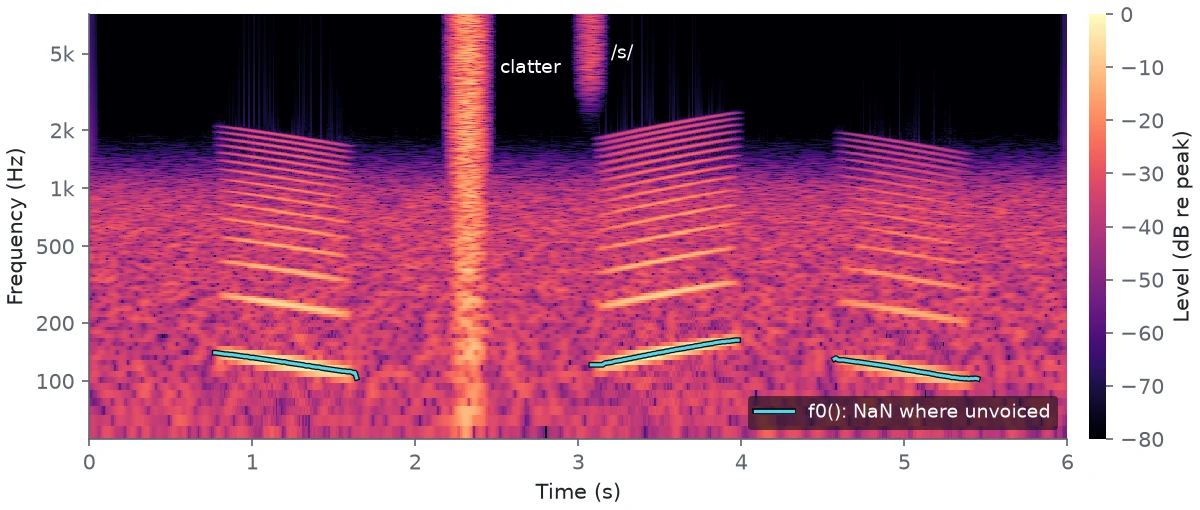
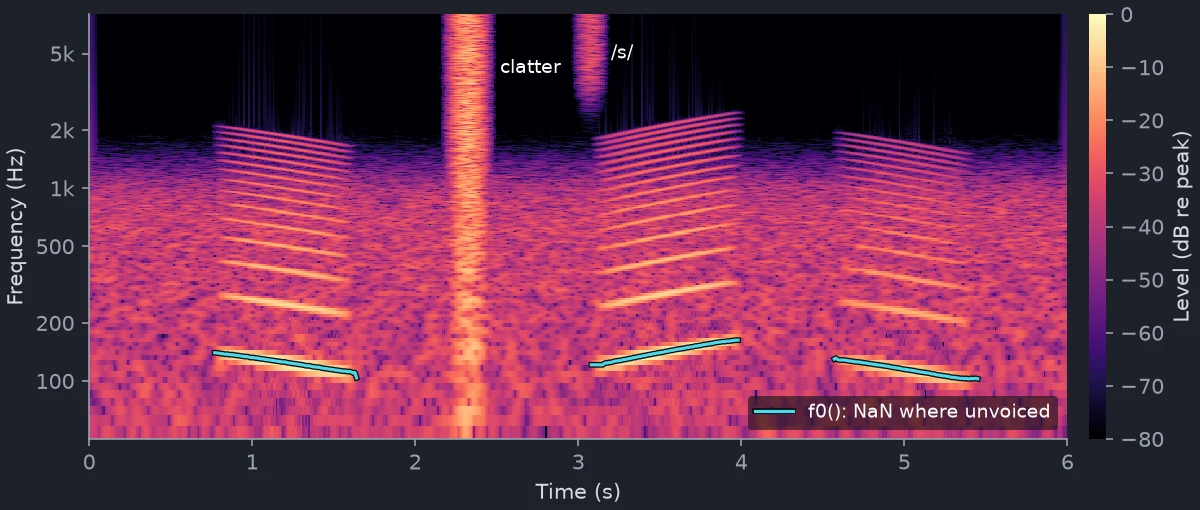
Drawn over the spectrogram of fan.wav, the contour follows each glide and
breaks off wherever there is only the clatter, the /s/ or the fan.
f0 takes one channel and, like vad, raises FeatureError on a
multichannel array. Read as one interleaved signal, fan.wav as two identical
columns would be a clip twice as long at half the pitch, 1201 frames at a
median of 65.0 Hz against the 601 frames at 125.6 Hz above.
pYIN measures periodicity, not the lowest line in a spectrogram. A 120 Hz
harmonic tone through bandpass's default
300 to 3400 Hz, the telephone band, comes out with its fundamental 68 dB down
and still reads 119.9 Hz.
The search range is a decision
The default range is 65 to 400 Hz
(SPEECH_FMIN and SPEECH_FMAX), from a low
male voice to a high female one. pYIN only looks inside it, and a pitch
outside it is not reported missing. It is reported as something inside:
sr = 16000
t = np.arange(sr) / sr
tone = 0.3 * sum(np.sin(2 * np.pi * 500 * k * t) / k for k in range(1, 10))

print(kudio.f0(tone, sr))                  # the speech range, 65-400 Hz
print(kudio.f0(tone, sr, fmax=1000))       # a range that holds 500 Hz
median 249.7 Hz  ·  249.7-249.7 Hz (0.0 semitones)  ·  100% voiced
median 499.4 Hz  ·  499.4-499.4 Hz (0.0 semitones)  ·  100% voiced
The first line is an octave low and 100 % voiced, and nothing in it looks
wrong. Below the range the answer sticks to the floor: tones at 50 and 60 Hz
both came back as 65.0 Hz, so a median sitting exactly on fmin is the sign
to look for. For singing or a child's voice, set the range yourself with
fmin and fmax.
These raise a FeatureError before pYIN
runs: an fmin that is not between 0 and fmax, an fmax above Nyquist,
and a frame_length that does not hold more than two periods of fmin,
2 * floor(sr / fmin) + 2 samples. Left out, frame_length is 2048, which
holds two periods of 65 Hz up to 66.56 kHz, or the next power of two that is
long enough above that: 4096 at 88.2 and 96 kHz. kudio pitch picks it the
same way. A frame_length you pass yourself is checked, never lengthened.
Reading the track
print(track) shows the median
(median_hz) and the 5th to 95th
percentile range (range_hz()),
because one octave error or one misjudged frame would move a mean or set a
minimum by itself. summary() returns
the same numbers as a dict, ready to be a CSV row.
voiced_ratio is the share of
frames with a pitch, which is not speech_ratio: an /s/ is speech without a
pitch. Even so, on fan.wav the voiced share is the larger, 45 % against
43 %, because vad lost the edges of the quiet last word behind the fan.
quiet.wav shows why the percentiles matter. pYIN's voicing does not look at
level, and it called 0.46 to 0.55 s of the quiet room's hiss voiced, at
exactly 65.0 Hz. That becomes the minimum, while range_hz() still starts at
101.5 Hz. To keep only the pitch inside the speech, ask
vad_frames for the track's hop; both are
centred by default, so the two line up frame for frame:
y, sr = kudio.file_load("quiet.wav")
track = kudio.f0(y, sr)
speech = kudio.vad_frames(y, sr, hop_length=track.hop_length)
inside = track.f0[track.voiced & speech]       # Hz, voiced and in a vad span
print(track.f0[track.voiced].min(), round(inside.min(), 1))
Labels: opening the result in an editor
A list of tuples is hard to check by eye. Turn the spans into
Label objects and the pitch track's voiced runs
into labels with to_labels(), and
save_labels writes each list as an
Audacity label track:
y, sr = kudio.file_load("fan.wav")
speech = [kudio.Label(a, b, f"speech {n}")
          for n, (a, b) in enumerate(kudio.vad(y, sr), 1)]
kudio.save_labels("fan.txt", speech)
kudio.save_labels("fan.voiced.txt", kudio.f0(y, sr).to_labels())
In Audacity, open fan.wav and add both files with File › Import › Labels;
the speech spans and the voiced runs sit as two tracks under the waveform.
to_labels() and
voiced_segments() leave out
voiced runs shorter than 0.05 s; min_seconds changes that. The label
formats, and reading a corrected track back with
load_labels, are on
Editing and effects.
kudio pitch fan.wav --segments --labels fan.voiced.txt does the pitch half
in one step: it prints the summary line and the voiced spans, writes the
label track, and exits 1 when nothing is voiced; see
Command line.