Rooms and channels
A recording reaches a file through three kinds of damage, and each is a different kind of arithmetic. Noise is additive: something else reaches the microphone alongside the speech, \(y + n\). A room is convolutive: it adds nothing, but smears every sound across the next few hundred milliseconds, for as long as the room rings, \(y \ast h\). The third is the link the recording travelled over, which kudio's functions call the channel. It is neither: a codec quantises, a converter throws bits away, a network drops packets, and none of that can be written as a sum or a convolution.
This page is about rooms and links; mixing in noise has its own page,
Building a noisy dataset. The examples share one setup, three
seconds of a stand-in for speech with pauses around two phrases. For a
recording of your own, load it with file_load
instead, which mixes down to mono unless you pass mono=False. Everything here
takes mono audio and refuses a (frames, channels) array with
FeatureError; read as one interleaved
signal, a two-channel copy of a 0.6 s response would measure T30 1.20 s with a
fit of 1.000. Put each channel through on its own.
import numpy as np
import kudio

sr = 16000
t = np.arange(3 * sr) / sr
# a 140 Hz voice with a 4 Hz syllable rhythm, silent between the phrases
voice = sum(np.sin(2 * np.pi * 140 * k * t) / k for k in range(1, 12))
y = 0.1 * voice * (0.5 + 0.5 * np.sin(2 * np.pi * 4 * t))
y[(t < 0.5) | ((t > 1.4) & (t < 1.9)) | (t > 2.6)] = 0.0
y += 0.003 * np.random.default_rng(0).standard_normal(t.size)   # a faint floor
y = y.astype(np.float32)
Why the kind matters
A tool that undoes one kind leaves the others alone.
spectral_enhance estimates a noise
spectrum and takes it out, and a room adds no spectrum to take out. The same
denoiser on the same clip, scored with si_sdr,
once with white noise at 5 dB SNR and once in a 0.6 s room:
noise = np.random.default_rng(1).standard_normal(len(y)).astype(np.float32)
noisy = kudio.add_noise_snr(y, noise, snr_db=5, seed=0)
wet = kudio.apply_rir(y, kudio.rir(sr, rt60=0.6, drr_db=6.0, seed=0))

for name, degraded in (("noise", noisy), ("room", wet)):
    before = kudio.si_sdr(y, degraded)
    after = kudio.si_sdr(y, kudio.spectral_enhance(degraded, sr))
    print(f"{name:5} {before:4.1f} dB -> {after:4.1f} dB SI-SDR")
Taking reverberation out is a different problem, and kudio does not attempt
it; the room functions make reverberation you control and measure it when you
have an impulse response. A link is not undone either: a lost packet is gone,
and all dropouts decides is what fills the hole. What can be taken out is on
Denoising.
The three always happen in the same order:
The room acts on the talker, the noise reaches the microphone beside what the room left, and the link carries whatever the microphone picked up, noise included. Building a noisy dataset applies the chain to a corpus and says what its SNR is measured against.
Rooms
Making one
rir builds an impulse response out of exponentially
decaying noise, the standard model of a diffuse reverberant tail. rt60 is
the time its envelope takes to fall 60 dB. drr_db is how far the direct path
sits above the reverberant energy, which is distance in a readable unit: +10 dB
or more is a close microphone, around 0 is a metre or two away, and the far end
of a hall is negative. The length defaults to 1.5 × rt60, enough for the
35 dB of decay T30 needs, and the same seed builds the same room.
drr_db is solved for with the 2.5 ms window the measurement uses, so in rooms
of 0.3 s and longer every value from −6 to +20 dB comes back to the hundredth
of a decibel; a 0.2 s room can miss the lowest values by half a decibel, and
shorter rooms by more. rt60 sets the envelope's slope, and with seed=0 and
the default drr_db a 0.2 s room measures 0.204 s and a 2.0 s room 1.994 s.
A drr_db below what the tail already puts inside the window is refused with
FeatureError rather than built differently. The shorter the room, the higher
that floor: −9.2 dB at 0.2 s, −13.3 dB at 0.5 s and −19.4 dB at 2.0 s, with
seed=0.
The room is a statistical one, with no early reflections and no walls, so it
will not stand in for a measured response when the shape of the early energy
is what you are studying. reverb is cruder
still, the direct sound and seven echoes, 50 ms apart by default, with no
reverberation time to ask for (Editing and effects has it). When
a number has to go on the dataset, use rir.
Putting a clip in it
apply_rir convolves, and by default does two
more things. It cuts the result back to the input's length (trim=True),
since a clip that grows each time it is processed stops lining up with
everything measured against it. And it puts the peak back where the input's
was (normalise=True), since a room with a loud direct path has a gain, and
an augmentation that also changes the level changes two things at once.
A synthetic room's direct path is its first sample. A recorded response starts
with the time the sound took to reach the microphone, which apply_rir keeps
as a delay, and apply_rir takes no sample rate. So load a recorded response
at the clip's rate and cut it at the direct sound:
measured, _ = kudio.file_load("measured_ir.wav", sr=sr)   # at the clip's rate
measured = measured[np.argmax(np.abs(measured)):]         # no time of flight
wet = kudio.apply_rir(y, measured)
Measuring one
rt60 returns a
Reverberation. T20, T30 and EDT are read
off one backward-integrated decay curve,
schroeder_curve: the time it takes to fall
from −5 to −25 dB, from −5 to −35 dB and from 0 to −10 dB, carried on to 60 dB.
Those are the evaluation ranges of ISO 3382-1, and T30 is the figure usually
quoted as the RT60. C50, C80 and DRR are energy ratios taken straight from the
response: the first 50 or 80 ms after the peak against everything later, and
±2.5 ms around it against the rest. fit is the R² of the line fitted for T30.
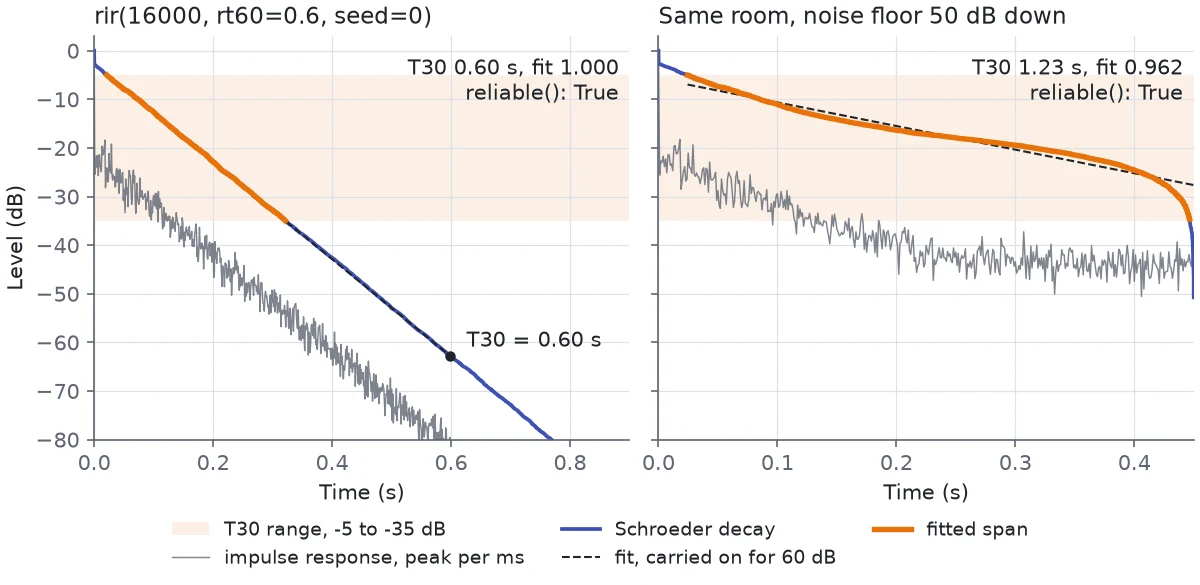
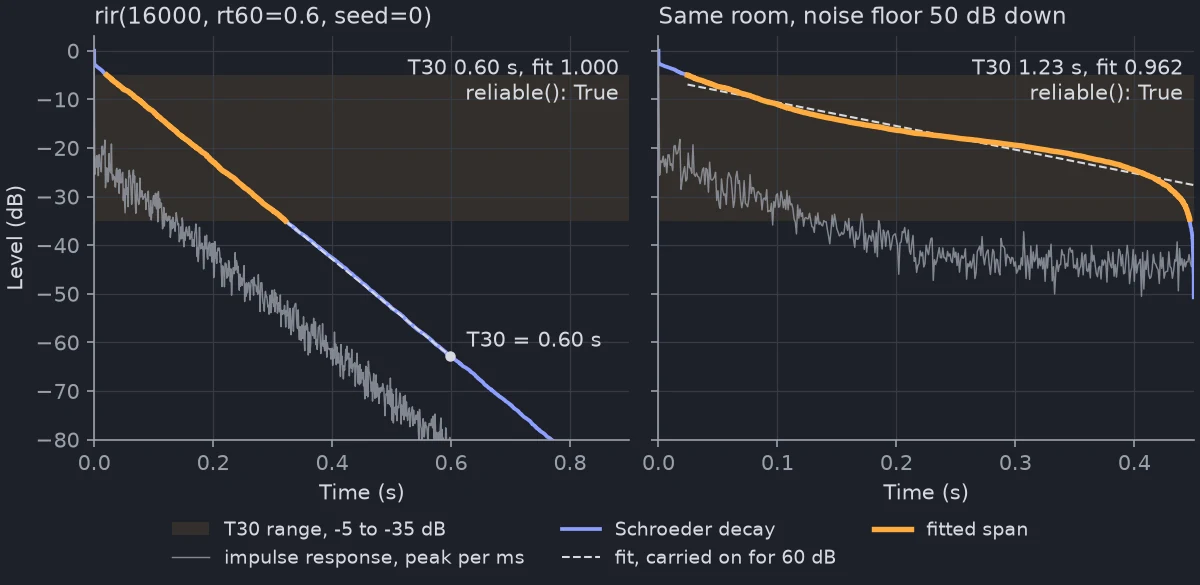
On the left, a 0.6 s room: from −5 to −35 dB the decay is a straight line, and the time that line takes to fall 60 dB is T30. The right panel belongs to the first warning below.
Read fit before the rest. Backward integration makes any signal decay, so
rt60 returns figures for noisy speech or a truncated response as readily as
for a room:
print(kudio.rt60(noisy, sr))
cut = kudio.rir(sr, rt60=1.0, seed=0)[:int(0.05 * sr)]   # 1 s room, 50 ms of it
room = kudio.rt60(cut, sr)
print(f"T30 {room.t30:.2f} s, fit {room.fit:.3f}, reliable: {room.reliable()}")
T30 2.62 s (EDT 18.47 s)  ·  C50 -11.2 dB  ·  DRR -20.3 dB  ·  fit 0.924  — but EDT and T30 disagree, so this may not be an impulse response
T30 0.19 s, fit 0.802, reliable: False
reliable() asks two questions. The
first is whether the decay was straight, a fit of at least 0.9; the cut room
fails it. The noisy speech passes it, which is why there is a second: whether
EDT and T30 agree. Away from the source the first 10 dB and the −5 to −35 dB
span describe the same tail, so EDT should be within a factor of
MAX_EDT_RATIO (2) of T30. That bound is a
sanity check, not a figure from the standard. Over forty seeds of the 0.6 s,
+6 dB room EDT/T30 stays between 0.87 and 1.16; the noisy speech puts it at 7.
A recorded response does not need cutting before it is measured. rt60
starts at the onset, the first sample within 20 dB of the peak, so the time of
flight is not counted as part of the decay: with 5 ms of silence in front of
it, the 0.6 s room still measures EDT 0.55 s and passes reliable().
rt60 also measures the whole band it is given, while room-acoustics reports
quote these figures per octave. For a band figure, filter with
zero_phase=False and cut at the peak again, since the filter delays the
direct sound: kudio.bandpass(ir, sr, low=355, high=710, zero_phase=False),
the 500 Hz octave, gives T30 0.60 s and EDT 0.49 s for the room above, where
the default zero-phase filter left EDT at 0.01 s. Read only the decay times
off the result; this +6 dB room measures a DRR of +0.1 dB in the band.
A noise floor is not taken out, and reliable() cannot see one
The right panel is the same 0.6 s room over white noise 50 dB below the
direct sound. Its tail starts only about 22 dB above the floor, and the
raw response (the grey trace) stops falling at about −45 dB, so the decay
curve falls too slowly and then drops at the cut. Cut at 0.45 s, T30 comes
back as 1.23 s with a fit of 0.962. No cut fixes it: from 0.15 to 0.45 s
the answer runs from 0.39 to 1.23 s, 0.54 s where the tail meets the floor,
and reliable() says True every time. A decay curve always falls past
−35 dB at a cut, so check the response itself: T30 means something only
when the raw response is still clear of the noise where the decay curve
crosses −35 dB. If it is not, the recording holds no T30 to quote, and the
answer is to measure again with more level.
reliable() cannot judge a microphone just under +10 dB DRR
Close to the source the direct sound fills the first 10 dB by itself, and
EDT drops: drr_db=9 gives 0.35 s against a T30 of 0.60 s, and drr_db=9.6
gives 0.04 s, which fails the EDT test on a decay that is perfectly
straight. From about +10 dB the decay curve falls past −10 dB in its first
sample, so there is no EDT at all. It comes back NaN, the summary says
"no EDT: the direct sound alone falls 10 dB", and reliable() judges on the
fit alone: rir(sr, rt60=0.6, drr_db=12, seed=0) passes with T30 0.60 s and
a fit of 1.000. Just under +10 dB, read fit and t30 and set the verdict
aside.
Channels
A phone line
telephone does what a narrowband line
does, in the order it does it: band-limit to 300–3400 Hz
(TELEPHONE_BAND) at the original
rate, resample to 8 kHz, compand through G.711 mu-law, and come back. The
band-pass comes first because the resampler's anti-alias filter is not the
line's passband. The result keeps the rate and the length it went in with, so
it sits beside its source in a dataset.
phone = kudio.telephone(y, sr)
print(len(phone) == len(y))
for problem in kudio.audio_report(phone, sr).problems():
    print(problem)
True
content stops at 3766 Hz although the file claims 16000 Hz — it was very likely upsampled from 8000 Hz, and the extra rate is empty
audio_report sees through it: the content
stops below 4 kHz, so it names 8 kHz as the rate the file really had.
Inspecting a recording explains how it decides.
Companding and bit depth
mu_law and
a_law push the signal through a G.711
companding curve, quantise it to 8-bit code words and expand it back. The
steps are logarithmic, so the quantisation noise follows the signal down
instead of sitting at a fixed floor. bit_depth
spends the same 8 bits linearly, and snr shows
what companding buys:
full = y / np.max(np.abs(y))
for level in (0, -6, -12, -18, -24):
    x = (full * 10 ** (level / 20)).astype(np.float32)
    print(f"{level:3} dBFS   mu-law {kudio.snr(x, kudio.mu_law(x)):.1f}   "
          f"A-law {kudio.snr(x, kudio.a_law(x)):.1f}   "
          f"8-bit linear {kudio.snr(x, kudio.bit_depth(x, 8)):.1f}")
  0 dBFS   mu-law 37.9   A-law 38.1   8-bit linear 40.2
 -6 dBFS   mu-law 37.9   A-law 38.1   8-bit linear 34.3
-12 dBFS   mu-law 37.7   A-law 38.0   8-bit linear 28.2
-18 dBFS   mu-law 37.4   A-law 37.7   8-bit linear 22.9
-24 dBFS   mu-law 36.6   A-law 36.6   8-bit linear 18.5
Over 24 dB of level, mu-law gives up 1.3 dB of SNR and linear 8-bit gives up 21.7 dB, close to the 24 dB that 6 dB per halving predicts.
These are the companding curves themselves, not the standard's
piecewise-linear segments. Against Python's audioop, which is G.711 itself
(and was removed in Python 3.13, so it cannot be a dependency), kudio's
round-trip SNR comes out 0.25 to 0.83 dB higher over the levels in the table,
and single samples differ by a few hundredths of full scale at most: close
enough for augmentation, and not a bit-exact decoder.
A full-scale sine through bit_depth comes back at \(6.02\,b + 1.76\) dB for
\(b\) bits: 49.9 dB at 8 bits and 98.1 dB at 16, on a 997 Hz tone.
dither=True adds triangular (TPDF) dither two steps wide, peak to peak,
before rounding, and costs 4.7 dB on that tone at 8 bits: the dither's own
power is twice the rounding error's, so the noise triples, which is 4.8 dB.
What that buys is an error that no longer depends on the signal. A sine a
quarter of a step high comes back at its full level on average (1.00 over 20
seeds), where without dither nothing of it comes back. Pass seed with it, or
every call dithers differently.
Packet loss
dropouts cuts the clip into packets of
packet_ms (default 20 ms, PACKET_MS, the
packet G.711 uses over RTP) and loses some of them. The count is fixed at
round(loss * packets) rather than drawn packet by packet, and it is rounded
per file: at 5%, a 1 s clip (50 packets) loses 2, which is 4%, and a clip of
0.2 s (10 packets) or less loses nothing. return_spans=True also returns
where each lost packet was, in seconds:
lossy, gaps = kudio.dropouts(y, sr, loss=0.05, seed=0, return_spans=True)
print(len(gaps), [f"{a:.2f}-{b:.2f} s" for a, b in gaps[:3]])
Three seconds is 150 packets, and 5% of 150 rounds to 8, or 5.3%.
conceal='silence', the default, leaves the holes empty. conceal='hold'
repeats the packet before each one, the crudest concealment a decoder does.
Across a run of lost packets it repeats the same 20 ms over and over, and a
packet lost at the very start stays silent because nothing came before it.
A waveform metric cannot choose a concealment
Whether hold scores better than silence depends on the talker's pitch
against the packet length. When a whole number of pitch periods fits in a
packet, the repeat lands in phase and is exact. A tenth of a period off,
it scores about the same as the hole; a third to a half of a period off,
it lands out of phase and scores 4 to 5 dB worse. kudio.snr with 10% of
packets lost from four seconds of a tone with nine harmonics (seed 2):
| Pitch | Cycles per 20 ms | silence |
hold |
|---|---|---|---|
| 100 Hz | 2.00 | 10.0 dB | exact |
| 105 Hz | 2.10 | 10.0 dB | 9.8 dB |
| 133 Hz | 2.66 | 10.0 dB | 5.6 dB |
| 150 Hz | 3.00 | 10.0 dB | exact |
| 175 Hz | 3.50 | 10.0 dB | 5.1 dB |
Choosing between the two on SNR or SI-SDR measures that accident, not the concealment. Measuring quality has what each metric does see.
Losses in runs
burst=None, the default, loses packets independently. Real links lose them
in runs (a fade, a queue overflowing, a handover), and a run is harder to
conceal than the same number of scattered packets: after its first packet
there is no recent speech left to repeat, so hold repeats one packet across
the whole run. burst= sets the mean run length in packets:
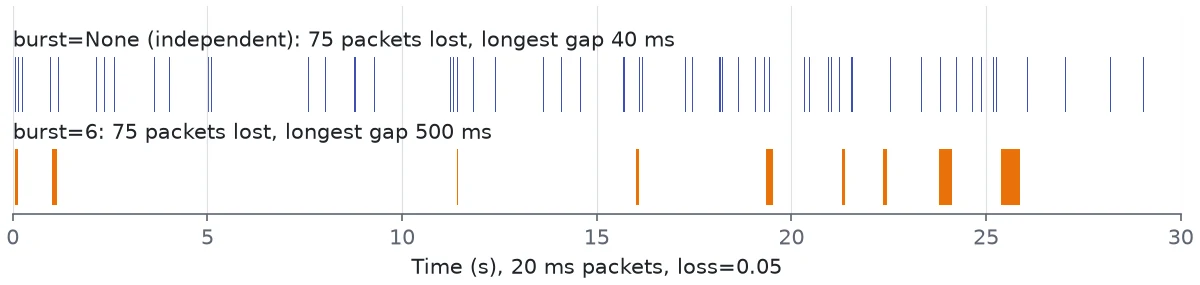
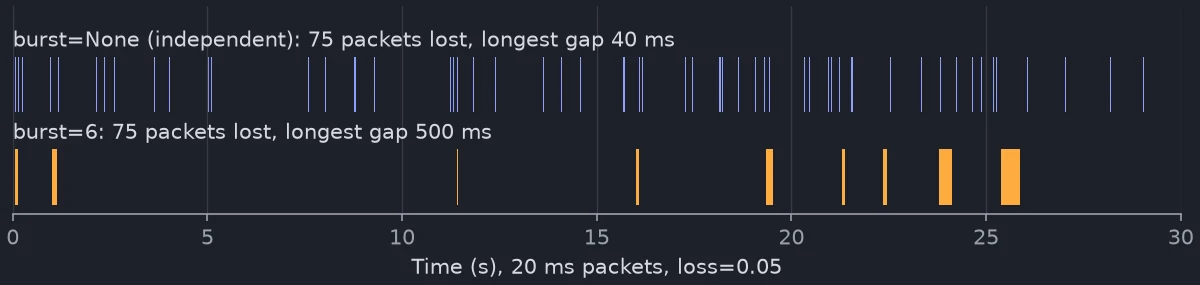
The run lengths are geometric, as in the bad state of Gilbert's two-state model, and runs stay at least one surviving packet apart, so two never join into one and the runs you count in the output are the runs that were drawn.
burst=1 is not the default under another name. Independent draws land side
by side now and then, so the default already averages 1 / (1 - loss) packets
a run, which independent_burst
returns: 1.05 at 5% loss, 1.25 at 20%. burst=1 asks for runs of exactly one,
which is less clustered than leaving it alone. The setup clip tiled to four
minutes (np.tile(y, 80)), 12000 packets with 600 of them lost, seed=0:
burst |
Runs | Mean run | Longest run |
|---|---|---|---|
None |
567 | 1.06 | 3 |
1 |
600 | 1.00 | 1 |
4 |
138 | 4.35 | 22 |
6 |
92 | 6.52 | 34 |
Each row is one draw, so the mean run lands near burst, not on it; over 50
seeds it comes to 5.9 for burst=6.
The whole link at once
apply_channel runs a link in the
order a link does it: band and rate, codec, converter, network. Packets are
lost from the encoded signal, so the loss goes last. The link is a spec: a
preset name, a dict of any of the
CHANNEL_DEFAULTS keys, or a preset
with overrides under a 'preset' key.
CHANNEL_PRESETS holds telephone
and telephone_a (the band and the 8 kHz rate, with mu-law or A-law), mu_law
and a_law (the codec alone, at full band), voip (mu-law at full band, 5%
loss in runs of 4, hold) and none.
channel_spec turns any of these forms
into one dict, and channel_tag into the
label a manifest carries: mu_law+loss10%x4-hold for
{"preset": "voip", "loss": 0.1}.
The order shows up in the samples. Lose the packets first and the band-pass
filter and the two resamplings inside telephone spread the speech on either
side into every hole:
right = kudio.apply_channel(y, sr, {"preset": "telephone", "loss": 0.1}, seed=0)
wrong = kudio.telephone(kudio.dropouts(y, sr, loss=0.1, seed=0), sr)
print(np.count_nonzero(right == 0.0), np.count_nonzero(wrong == 0.0))
In the right order the 15 lost packets are 4800 samples of exact silence, 320 to a packet; in the wrong order not one sample is zero.
channel_spec refuses an unknown setting, codec or concealment, a loss
outside 0 to 1, fewer than 2 bits, a burst under 1 and a packet_ms of zero
or less. apply_channel and Synthesizer call it before any audio goes
through, so a Synthesizer given a bad link fails when it is built, not on its
first file. A spec's band is on or off; for other edges, call
telephone(..., band=) yourself.
The whole chain for one clip, room, noise and link in that order:
wet = kudio.apply_rir(y, kudio.rir(sr, rt60=0.5, drr_db=3.0, seed=0))
mix = kudio.add_noise_snr(wet, noise, snr_db=10, seed=0)
out = kudio.apply_channel(mix, sr, "voip", seed=0)
A Synthesizer takes the same spec as
channel= and applies it to every finished mixture; Building a noisy
dataset covers the per-file seeding, the manifest tag and why
the link is not an axis.
From the command line
kudio room measures a response and exits 1 when reliable() is False.
--make builds a room, and --apply puts a file through a synthetic one
built from --rt60, --drr and --seed; a recorded response goes through
apply_rir in Python. kudio channel degrades a file and reports what it
did, including the runs it lost.
kudio room ir.wav
kudio room --make room.wav --rt60 0.6 --drr 6 --seed 0
kudio room speech.wav --apply wet.wav --rt60 0.6 --seed 0
kudio channel in.wav out.wav --telephone
kudio channel in.wav out.wav --loss 0.05 --burst 6 --conceal hold --seed 0
The flags are on Command line, and every parameter of every function here is in the reference.