Denoising
kudio.enhance is single-channel statistical denoising: no model, no training
data, nothing to download. It estimates the noise, works out how much speech
each time-frequency bin holds, and turns each bin down accordingly. Seven gain
rules and four noise estimators share one STFT loop, so any rule runs over any
estimator, and four of the rules also run on a live stream.
| You have | Reach for |
|---|---|
| one noisy clip | spectral_enhance |
| a clip, and the question of which method suits it | compare_enhancers |
| audio that is still arriving | StreamEnhancer |
| a folder of recordings | enhance_folder |
The clip the examples run on
Five seconds at 16 kHz: two harmonic "voices" with pauses before, between
and after them, and white noise mixed in at 5 dB SNR with
add_noise_snr. That SNR is over
the whole clip, pauses included; while the voices are speaking it is
7.0 dB. It is seeded, so the blocks below, run after this one, print what
the page shows.
import numpy as np

import kudio

sr = 16000
t = np.arange(sr * 5) / sr
rng = np.random.default_rng(0)

def voice(start, stop, f0):
    """Thirteen harmonics of f0, rising and falling 3.5 times a second."""
    span = (t >= start) & (t < stop)
    tone = sum(np.sin(2 * np.pi * f0 * k * t) / k for k in range(1, 14))
    swell = 0.5 + 0.5 * np.sin(2 * np.pi * 3.5 * t)
    return np.where(span, tone * swell / 7, 0.0)

clean = (voice(0.5, 2.0, 140) + voice(2.8, 4.5, 170)).astype(np.float32)
noisy = kudio.add_noise_snr(clean, rng.standard_normal(len(clean)),
                            snr_db=5, seed=0)
One call
enhanced = kudio.spectral_enhance(noisy, sr)   # log-MMSE, MCRA noise estimate
before, after = kudio.si_sdr(clean, noisy), kudio.si_sdr(clean, enhanced)
print(f"SI-SDR {before:.2f} dB -> {after:.2f} dB")
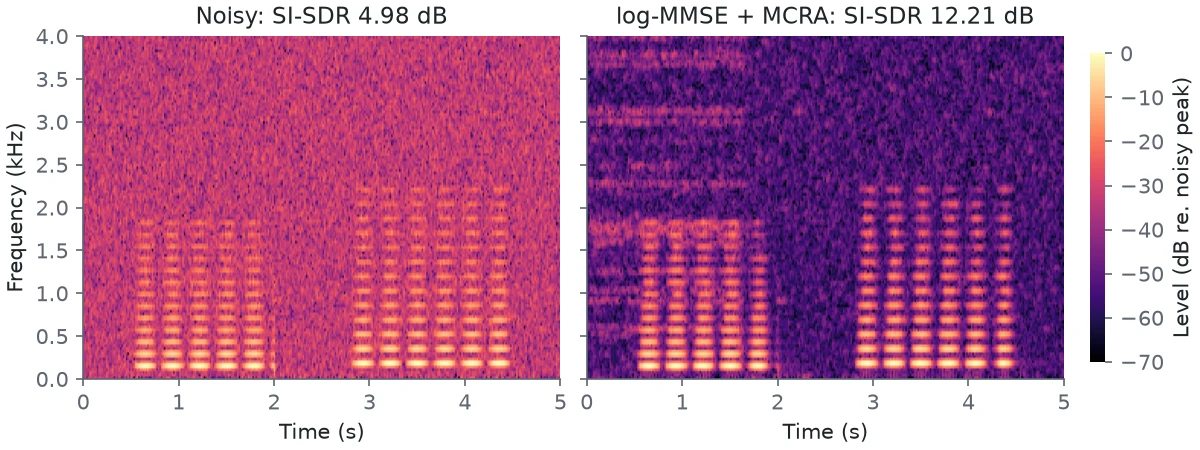
The streaks in the first two seconds are the MCRA noise estimate settling; Four noise estimators says why.
The output is float32, as long as the input and in step with it sample for
sample, so it goes straight into a metric or an A/B. The audio has to be mono,
and a clip shorter than one frame (512 samples unless you pass n_fft=) is
refused rather than padded. The method's own parameters are keywords, and one
it does not take is an error:
Noise estimate, then gain
For each STFT frame \(l\) and bin \(k\), every method estimates the noise power
\(\lambda_d(k,l)\) with one of four estimators (noise=) and turns it into a
gain between a floor and 1, which multiplies the complex spectrum and leaves
the noisy phase alone. wiener, mmse_stsa, logmmse and omlsa take one
more step in between: the decision-directed estimate of the a priori SNR
\(\xi(k,l)\), how much speech the bin holds, from Ephraim and Malah4. They
differ only in the gain function after it:
\(\hat S(k,l-1)\) is the previous frame's speech estimate. At \(\alpha = 0.98\) the
estimate leans almost entirely on it, which keeps musical noise down and makes
these four slow to open up at a speech onset. \(\gamma\) is clamped at 40 dB,
since one loud frame would otherwise drag the estimate somewhere it takes
seconds to leave, and \(\xi\) is floored at −25 dB. specsub, multiband and
spectral_gate go from the noise estimate straight to a gain.
I keep the estimator and the gain rule apart so one can be held still while
the other varies. On this clip the seven rules over one estimator span 5.7 dB
of SI-SDR on average, and the four estimators under one rule span 7.5 dB.
Which matters more depends on the recording, which is why
compare_enhancers can sweep both.
Seven gain rules
| Method | What it does | Why you would pick it | Its own parameters |
|---|---|---|---|
specsub |
Subtracts a multiple of the noise power: Boll's method1 with Berouti's over-subtraction and floor2 | Cheapest; the origin of "musical noise" | over_subtraction 2.0, spectral_floor 0.002 |
multiband |
Subtraction with a factor per band: 4.75 below −5 dB band SNR, sliding to 1.0 above 20 dB3 | Colored noise is not equally loud everywhere | bands 6, spectral_floor 0.002 |
wiener |
Gain \(\xi/(1+\xi)\) | Smooth, so little musical noise; muffles at low SNR | alpha 0.98 |
mmse_stsa |
MMSE estimate of the amplitude4 | Keeps more speech than Wiener | alpha 0.98 |
logmmse |
MMSE in the log-amplitude domain5 | The default; with MCRA it came within 0.05 dB of the best rule on this clip | alpha 0.98 |
omlsa |
log-MMSE weighted by a speech-presence probability6 | Takes bins it judges speech-free down to the gain floor, so the pauses here come out about 3 dB quieter than log-MMSE's; q sets how readily a bin counts as empty |
alpha 0.98, q 0.30 |
spectral_gate |
Keeps bins more than n_std_thresh times the noise estimate's spread over time (in dB) above it, through a smoothed mask |
A plain threshold, as in noisereduce. On this page's white noise it came last under every estimator and turned the speech down 5 dB along with the noise | n_std_thresh 1.5, prop_decrease 1.0, freq_smooth_hz 500, time_smooth_ms 50 |
A noise estimate that holds still has next to no spread over time, quantile
none at all and initial only over the opening frames it averages, so with
those spectral_gate's threshold sits on the estimate or just above it. All
the others also take gain_floor_db, −25 dB by default: how far
any bin may be turned down. A hard zero is the wrong goal, because total
suppression is what makes the residue warble. For the same \(\xi\) and \(\gamma\),
Wiener turns a bin down furthest, MMSE-STSA least and log-MMSE in between, and
at high SNR MMSE-STSA comes out the same as Wiener. The test suite checks both.
METHODS holds all of this as data. Each
entry is a Method whose
Params carry a default, range, step, unit and
a sentence of help, enough for a GUI or a command line to build its controls
without restating them:
q = {p.name: p for p in kudio.METHODS["omlsa"].params}["q"]
print(q.default, q.low, q.high, q.step)
print(q.help)
0.3 0.01 0.95 0.05
A priori probability that a bin holds no speech. Higher suppresses more and risks clipping onsets.
Four noise estimators
| Estimator | What it assumes | noise_kwargs and defaults |
Streams |
|---|---|---|---|
mcra |
The noise is a running average of each bin's power, held still where the bin sits more than 5 times above its running minimum, since it probably holds speech there7 | window=100 frames, delta=5 (also ass, ad, ap) |
yes |
quantile |
The noise is a low quantile of each bin over the whole file, scaled up to the mean of steady noise | quantile=0.15 |
no |
initial |
The opening frames are noise alone; their mean is held from then on | n_frames=6 |
yes |
minimum |
The noise is a sliding-window minimum of the smoothed spectrum, times a fixed bias | window=60, bias=1.5, smoothing=0.85 |
yes |
mcra is the default. NOISE_ESTIMATORS
holds a sentence on each, and on this clip the choice moves the result more
than the gain rule does:
print(kudio.NOISE_ESTIMATORS["initial"])
for noise in kudio.NOISE_ESTIMATORS:
    out = kudio.spectral_enhance(noisy, sr, "logmmse", noise=noise)
    print(f"{noise:9} {kudio.si_sdr(clean, out):.2f} dB")
Average of the first few frames, assumed to be room tone. Exact when that is true and badly wrong when it is not.
mcra      12.21 dB
quantile  14.16 dB
initial   14.86 dB
minimum   6.86 dB
initial wins here because the clip opens with half a second of noise and
nothing else, which is its assumption exactly. Its six frames reach 56 ms into
the clip at 16 kHz with the default framing. The frame is 512 samples whatever
the rate, so at 48 kHz the same six frames reach 19 ms; raise n_frames when
the room tone lasts longer.
mcra explains the streaks in the figure above. Its estimate and its running
minimum both start from the first frame, and the offline STFT is centered, so
half of that frame is zero padding: here a third of its bins start more than
7 dB under the noise. Such a bin looks like speech, so its estimate holds
still, and it stays too low until the minimum search has run through two
100-frame windows, 1.6 s at 16 kHz. The opening half second keeps about 10 dB
more residual noise than the pause at 2.0–2.8 s (−38.5 against −48.1 dBFS). In
a recording that opens with a few seconds of room tone, that is over before
anyone speaks.
quantile takes the 15th percentile of each bin over the whole file and
scales it up. Steady noise power in a bin is exponentially distributed, so its
q-th percentile sits a factor of \(-\ln(1-q)\) under its mean, 7.9 dB at the
default, and the estimate is divided by that. Without assuming anything about
how the file opens, it lands within 0.7 dB of initial here. The quantile has
to stay below the share of the file in which a bin holds no speech: at
noise_kwargs={"quantile": 0.5} speech gets into the statistic and this clip
drops to 12.87 dB. noise_kwargs goes to the estimator, and a key it does not
take is refused with a FeatureError that lists the ones it does.
For a loop of your own,
estimate_noise_psd runs any
estimator over a (frames, bins) power spectrogram, and
make_noise_tracker gives every
one but quantile as state plus a one-frame update.
DecisionDirected does the same for
the a priori SNR, and make_gain_rule
returns the gain function of one of the four decision-directed rules, without
the floor: clip its output to [10 ** (gain_floor_db / 20), 1] as
spectral_enhance does. The offline and the streaming path are both built
from these objects, so they share every update rule.
Choosing a method
compare_enhancers runs several
methods over one clip and measures each. A run is a (method, estimator) pair:
methods= picks the rules (all seven when omitted), noises= sweeps the
estimators, and the two together give the full grid.
results = kudio.compare_enhancers(noisy, sr, reference=clean,
                                  noises=list(kudio.NOISE_ESTIMATORS),
                                  metrics=False)
ranked = sorted((r for r in results if not r.error),
                key=lambda r: r.si_sdr_db, reverse=True)
print(len(ranked))
for r in ranked[:4]:
    print(f"{r.label:20} SI-SDR {r.si_sdr_db:+.2f} dB",
          f"  dSNR {r.delta_snr_db:+.2f} dB")
28
wiener + initial     SI-SDR +15.37 dB   dSNR +10.48 dB
omlsa + initial      SI-SDR +15.26 dB   dSNR +10.36 dB
logmmse + initial    SI-SDR +14.86 dB   dSNR +10.00 dB
multiband + quantile SI-SDR +14.52 dB   dSNR +9.65 dB
Each row is an EnhanceResult with
the time, noise floor and loudness. With reference= it also has SNR, SI-SDR
and delta_snr_db, and with metrics=True, the default, PESQ and STOI from
kudio[pesq] and kudio[eval] where installed (PESQ only at 8 and 16 kHz).
They are most of the time a comparison takes: on my machine the 28 runs above
took 2.0 s with STOI and 1.0 s without. A run that raises comes back as
a row with error set, its floor and loudness NaN and its scores None, so
filter those out before sorting, as above. The clock starts after a warm-up run, so the first method
is not charged for librosa's JIT compilation.
delta_snr_db is the output's SNR minus the untouched input's, both against
the reference: the number that answers "did this help". It is plain SNR, so a
method that also turns the speech down pays for it, while SI-SDR ignores level.
The two can tell different stories. In the same 28 runs, spectral_gate + mcra
gains 3.15 dB of SI-SDR (4.98 to 8.13) but only 1.16 dB of SNR, because it
turns the speech down 5 dB along with the noise. pesq_mode= and
pesq_scale= go to PESQ; Measuring quality explains which scale
a paper means.
Other keywords go to each run that accepts them and are dropped for the rest,
the opposite of spectral_enhance:
q=0.9 reaches omlsa alone, so it can share a call with six methods that
have no q, while n_fft= and noise_kwargs= reach every run. A keyword that
no method in the call takes is a typo, and is refused before anything runs; a
noise_kwargs key that only one swept estimator takes fails the others' runs.
noise="initial" fixes the estimator instead of sweeping it; together with
noises= it is refused.
Without a reference, the normal case for a real recording, you get the noise
floor (the 10th percentile of 30 ms frame levels, as
audio_report measures it on
Inspecting a recording) and the loudness:
for r in kudio.compare_enhancers(noisy, sr, ["wiener", "logmmse", "omlsa"]):
    print(f"{r.label:16} floor {r.noise_floor_db:.1f} dBFS   {r.lufs:.1f} LUFS")
wiener + mcra    floor -53.6 dBFS   -24.4 LUFS
logmmse + mcra   floor -48.6 dBFS   -24.3 LUFS
omlsa + mcra     floor -51.2 dBFS   -24.5 LUFS
The lowest floor is not the best result: wiener leaves the least noise here
and still scores below logmmse against the reference, 11.84 against
12.21 dB. Neither column says what happened to the speech, so listen before
trusting the smallest number.
Ranking your own denoiser
A trained model, a wrapper around another library or a one-off experiment can
sit in the same table: pass a function of (y, sr) that returns the enhanced
waveform, bare or as (name, function).
def lowpassed(y, sr):
    return kudio.lowpass(kudio.spectral_enhance(y, sr), sr, 4000)

for r in kudio.compare_enhancers(noisy, sr, ["logmmse", kudio.trad_enhance,
                                             ("lowpassed", lowpassed)],
                                 reference=clean, metrics=False):
    print(f"{r.label:20} SI-SDR {r.si_sdr_db:+.2f} dB")
logmmse + mcra       SI-SDR +12.21 dB
trad_enhance + own   SI-SDR +14.09 dB
lowpassed + own      SI-SDR +13.08 dB
A bare function is named after itself, and the estimator column reads own
(CUSTOM_NOISE): it brings its own
noise handling, so it runs once even when noises= sweeps the built-in ones.
CustomEnhancer is the same entry as
an object. A model trained with
KudioEnhance goes in the same way,
as ("model", Enhancer.load(run_dir).enhance) with Enhancer from
kudioenhance.inference. The reference metrics compare the samples both
signals have, so an output that comes back a little short is fine, and a
delayed one is not: line it up first, as Measuring quality shows.
Where it does not help
Two limits, measured on the voices above
These methods are for noisy audio. Each one trades speech distortion for
noise removal, and the trade gets worse as the input gets cleaner. Here is
delta_snr_db in dB over MCRA, with white noise mixed into the clean
voices at each input SNR:
| Input SNR | Best | Worst of the other six | spectral_gate |
|---|---|---|---|
| −5 dB | +10.5 | +6.9 | +6.5 |
| 0 dB | +9.0 | +6.5 | +3.9 |
| 5 dB | +7.6 | +6.0 | +0.4 |
| 10 dB | +5.9 | +4.3 | −4.6 |
| 15 dB | +3.1 | +0.5 | −9.9 |
| 20 dB | −0.1 | −4.0 | −15.0 |
spectral_gate drops below zero from 10 dB. The other six keep gaining up
to 15 dB, and at 20 dB all seven leave the clip worse than they found it.
That is why every EnhanceResult carries delta_snr_db.
They need to hear the noise on its own. MCRA learns the noise in the gaps
between words. The same voices back to back, without the pauses, give it
almost nothing to learn from, and initial then averages speech and calls
it noise. A second of room tone in front is what initial is for:
delta_snr_db of logmmse, 5 dB input SNR |
mcra |
initial |
|---|---|---|
| With pauses | +7.6 | +9.4 |
| No pauses | +1.3 | −2.4 |
| No pauses, one second of room tone first | +3.7 | +8.7 |
How the two tables were measured
noise = np.random.default_rng(1).standard_normal(len(clean))
for snr_in in (-5, 0, 5, 10, 15, 20):
    mixed = kudio.add_noise_snr(clean, noise, snr_db=snr_in, seed=0)
    runs = kudio.compare_enhancers(mixed, sr, reference=clean,
                                   metrics=False)
    delta = {r.method: r.delta_snr_db for r in runs}
    gate = delta.pop("spectral_gate")
    print(f"{snr_in:+3d} dB  best {max(delta.values()):+5.1f}",
          f" worst of six {min(delta.values()):+5.1f}  gate {gate:+5.1f}")

steady = (voice(0.0, 2.5, 140) + voice(2.5, 5.0, 170)).astype(np.float32)
lead_in = np.concatenate([np.zeros(sr, np.float32), steady])
cases = {"pauses": clean, "no pauses": steady, "room tone": lead_in}
for name, signal in cases.items():
    hiss = np.random.default_rng(1).standard_normal(len(signal))
    mixed = kudio.add_noise_snr(signal, hiss, snr_db=5, seed=0)
    deltas = [kudio.compare_enhancers(mixed, sr, ["logmmse"], noise=est,
                                      reference=signal,
                                      metrics=False)[0].delta_snr_db
              for est in ("mcra", "initial")]
    print(f"{name:10} mcra {deltas[0]:+.1f}  initial {deltas[1]:+.1f}")
 -5 dB  best +10.5  worst of six  +6.9  gate  +6.5
 +0 dB  best  +9.0  worst of six  +6.5  gate  +3.9
 +5 dB  best  +7.6  worst of six  +6.0  gate  +0.4
+10 dB  best  +5.9  worst of six  +4.3  gate  -4.6
+15 dB  best  +3.1  worst of six  +0.5  gate  -9.9
+20 dB  best  -0.1  worst of six  -4.0  gate -15.0
pauses     mcra +7.6  initial +9.4
no pauses  mcra +1.3  initial -2.4
room tone  mcra +3.7  initial +8.7
Audio that is still arriving
StreamEnhancer runs the same
update a block at a time, so a take can be heard through the denoiser while it
is being recorded. Blocks can be any size:
process returns whatever
audio is finished, and flush
the rest once nothing more is coming.
enhancer = kudio.StreamEnhancer(sr, "logmmse")
print(f"latency {enhancer.latency_seconds * 1000:.0f} ms")

pieces = [enhancer.process(noisy[i:i + 1024])       # one 64 ms block at a time
          for i in range(0, len(noisy), 1024)]
pieces.append(enhancer.flush())
streamed = np.concatenate(pieces)
print(len(noisy), len(streamed))
print(f"streamed {kudio.si_sdr(clean, streamed):.2f} dB,",
      f"offline {kudio.si_sdr(clean, enhanced):.2f} dB")
The latency is one analysis frame, n_fft / sr: nothing comes out until a
whole frame has arrived, and then the output follows in hop-sized pieces. That
is a wait, not a shift, so sample i of everything concatenated lines up with
sample i of the input. flush() zero-pads the last partial frame so the tail
is processed rather than dropped, and stops where the input stopped, so the
whole output is as long as the input. The test suite feeds the same audio in blocks of
1, 7, 128, 512, 1024 and 9999 samples and gets the same output to within
10⁻⁶. reset clears every
buffer and estimate for the next take.
Streamed and offline output are close but not identical. A stream's first
frame is a whole one, while the offline STFT's is half zero padding, and with
mcra that start is worth something to the stream: over ten noise draws of
this clip it came out 0.8 to 1.6 dB of SI-SDR ahead every time. With initial
and minimum the two stay within 0.7 dB.
Four methods stream, the ones in
STREAMABLE_METHODS: wiener,
mmse_stsa, logmmse and omlsa, over mcra, initial or minimum.
spectral_gate cannot: it sets its threshold from the spread of the noise
estimate over the whole file and smooths its mask forwards and backwards in
time. Nor can quantile, a statistic of the whole file. A streaming version of
either would be a different algorithm under the same name. specsub and
multiband only need the current frame, but StreamEnhancer runs the
decision-directed loop and nothing else, so it does not take them. Asking for
any of the three is a FeatureError that lists the four that stream and gives
the spectral_enhance call that runs the method offline.
From a microphone, feed it
StreamRecorder.drain() and never
tail(): tail() hands out
overlapping windows, and samples seen twice corrupt every recursive estimate
the enhancer holds. Keep the recorder mono: process() refuses a
two-channel block with a FeatureError.
Recording and live views has the loop.
A whole folder
enhance_folder denoises every .wav
file under one folder into another, mirroring the subfolders the way
convert_folder does, so two takes with the
same name in different folders do not collide:
hiss = np.random.default_rng(1).standard_normal(len(clean))
for name, snr_db in [("day1/take1.wav", 0), ("day1/take2.wav", 5),
                     ("day2/take1.wav", 10)]:
    kudio.save_wave(f"noisy/{name}",
                    kudio.add_noise_snr(clean, hiss, snr_db=snr_db, seed=0), sr)

result = kudio.enhance_folder("noisy", "enhanced", "logmmse", report=True)
print(result)
for path, before, after in result.floors:
    print(f"{path.as_posix()}: floor {before:.1f} -> {after:.1f} dBFS")
print(f"{result.mean_reduction_db():.1f} dB down on average")
3/3 written, 0 failed
enhanced/day1/take1.wav: floor -24.4 -> -43.5 dBFS
enhanced/day1/take2.wav: floor -29.4 -> -48.4 dBFS
enhanced/day2/take1.wav: floor -34.4 -> -53.3 dBFS
19.0 dB down on average
The result is an EnhanceFolderResult:
a ConvertResult, false in an if when
anything failed, plus the floors that report=True measures. Parameters are
checked once, before the first file, so a typo is one error and not one
failure per file. noise=, n_fft=, hop_length=, window= and
noise_kwargs= go to spectral_enhance
as they would in a single call, and the method can also be anything
compare_enhancers accepts, a trained model included. A list or a .txt list
of files is mirrored from the deepest folder they share, the way
convert_folder does it. Each file is loaded as mono and written
as 16-bit PCM, and the reference
covers sr=, subtype=, on_error=, progress= and overwrite=. A second
run into the same folder keeps what is there and writes the new
day1/take1.wav as day1/take12.wav unless overwrite=True.
Two fixed recipes
trad_enhance is one fixed recipe
from Loizou's Speech Enhancement: Theory and Practice: 512-sample Hamming
frames at 50 % overlap, an MCRA noise estimate, power spectral subtraction
with an over-subtraction factor set from each frame's SNR, then a Wiener-style
gain. There is nothing to tune or sweep, and it does well on this clip:
out = kudio.trad_enhance(noisy, sr)
print(len(noisy), len(out), out.dtype)
print(f"{kudio.si_sdr(clean, out):.2f} dB")
The output is as long as the input. Its frames step by 256 samples, so a tail
shorter than that has no frame of its own and comes back silent: the last 128
samples here, 8 ms. A clip shorter than one 512-sample frame is refused with
FeatureError, since it would come back as silence.
wavelet_low_pass_filter
soft-thresholds the detail coefficients of a full db2 decomposition with one
threshold for every level, thres times the clip's peak, max |y|. The
fine levels go first, so it acts as a low-pass, and at the default thres=0.8
a heavy one: on this clip the voices themselves lost 7.6 dB below 1 kHz, and
SI-SDR fell from 4.98 to 4.00 dB (11.20 dB at thres=0.1). The output has
the input's length, and a silent clip comes back as it went in. For a plain
cutoff frequency, the
Butterworth filters in Editing and effects are the tool.
From the command line
kudio enhance runs
spectral_enhance on a file, and
kudio compare runs
compare_enhancers, best first
when there is a reference:
kudio enhance in.wav out.wav --method omlsa --noise mcra --set q=0.4
kudio compare in.wav --reference clean.wav
kudio compare in.wav --reference clean.wav --noises all   # the full grid
Command line lists every option.
-
S. F. Boll, "Suppression of acoustic noise in speech using spectral subtraction", IEEE Trans. Acoust., Speech, Signal Process. 27(2), 1979. ↩
-
M. Berouti, R. Schwartz and J. Makhoul, "Enhancement of speech corrupted by acoustic noise", ICASSP 1979. ↩
-
S. Kamath and P. Loizou, "A multi-band spectral subtraction method for enhancing speech corrupted by colored noise", ICASSP 2002. ↩
-
Y. Ephraim and D. Malah, "Speech enhancement using a minimum mean-square error short-time spectral amplitude estimator", IEEE Trans. Acoust., Speech, Signal Process. 32(6), 1984. ↩↩
-
Y. Ephraim and D. Malah, "Speech enhancement using a minimum mean-square error log-spectral amplitude estimator", IEEE Trans. Acoust., Speech, Signal Process. 33(2), 1985. ↩
-
I. Cohen and B. Berdugo, "Speech enhancement for non-stationary noise environments", Signal Processing 81(11), 2001. ↩
-
I. Cohen and B. Berdugo, "Noise estimation by minima controlled recursive averaging for robust speech enhancement", IEEE Signal Process. Lett. 9(1), 2002. ↩