STFT and features
Most of what a model gets from kudio is a matrix with one row per frame, whether a log-power spectrogram, MFCCs or stacked log-mel vectors. Shapes are where these go wrong, so every section below says what comes back.
| To | Use |
|---|---|
| get a log-power spectrogram and keep its settings with the model | STFT, or waveform_to_spectrogram for a one-off |
| get compact features for a classifier | melspectrogram, mfcc |
| give every row its neighbours, or cut fixed-length windows | stack_context, ContextFrames, frame_windows |
| scale features with the training set's statistics | Standardizer |
| turn a predicted spectrogram back into audio | STFT.inverse, save_spectrogram_as_wave |
| apply a complex mask or gain | STFT.analyse and STFT.synthesise |
| compute log spectrograms or MFCCs for a list of files | logspec_from_files, mfcc_from_files |
| mark which frames hold speech | vad_frames, on Speech activity and pitch |
All of these work on a whole clip. To draw a spectrogram while the audio is
still arriving, use SpectrogramStream
(Recording and live views). Its columns are framed
differently (a Hann window, a hop of n_fft // 4, not centred) and hold dB
rather than bels, so a model trained on the rows here should not be fed them.
The examples run in order on one two-second clip at 16 kHz, and later blocks
use names made in earlier ones (stft, spec, windows, std). Load a
recording of your own with file_load, or follow
along with noise:
import numpy as np
import kudio

sr = 16000
y = (0.1 * np.random.default_rng(0).standard_normal(2 * sr)).astype(np.float32)
Rows are frames
librosa returns (bins, frames). Every function on this page returns
(frames, bins), time first: a row is one moment of the signal, which is what
a frame classifier takes as one sample and what a sequence model steps along.
Transpose only for code that puts frequency first:
plt.imshow(spec.T, origin="lower", aspect="auto") to draw frequency upwards,
librosa.display.specshow(spec.T), and kudio's own
spec_augment, whose call and mask
value are on Editing and effects.
For the clip above, with every other argument at its default (spec is the
first row's result):
| Call | Shape | This clip | Values |
|---|---|---|---|
kudio.waveform_to_spectrogram(y) |
(frames, n_fft // 2 + 1) |
(126, 257) |
log10 power, float32 |
kudio.STFT().analyse(y) |
(frames, bins) |
(126, 257) |
complex64 |
kudio.mfcc(y, sr) |
(1, mel_frames, n_mfcc) |
(1, 63, 40) |
float32 |
kudio.melspectrogram(y, sr=sr) |
(mel_frames - n_frames + 1, n_mels * n_frames) |
(59, 320) |
dB, float32 |
kudio.melspectrogram(y, sr=sr, n_frames=1) |
(mel_frames, n_mels) |
(63, 64) |
dB, float32 |
kudio.stack_context(spec, 2) |
(frames, bins * 5) |
(126, 1285) |
edge-padded, float32 |
kudio.frame_windows(spec, 64) |
(ceil(frames / 64), 64, bins) |
(2, 64, 257) |
tail padded, float32 |
kudio.spectrogram_to_waveform(y, spec) |
(len(y),) |
(32000,) |
float32 |
Here a frame is one position of the STFT window, not a row of the
(frames, channels) arrays on Audio files. frames above is
len(y) // 256 + 1, 126 for this clip; mel_frames is the same count at the
512-sample hop of mfcc and
melspectrogram, 63 here.
melspectrogram takes hop_length=; mfcc does not.
One object for the STFT settings
A spectrogram and the waveform rebuilt from it have to agree on n_fft,
hop_length, win_length and window. Passed by hand to two functions, the
four drift apart the first time someone changes one of them, so
STFT keeps them together as one value, the geometry
of the transform, along with the sample rate they were chosen for. Its
forward is
waveform_to_spectrogram with
those settings:
stft = kudio.STFT(sr=16000, n_fft=512, hop_length=256)
print(stft.win_length, stft.window)             # 512 hamming
print(stft.n_bins, stft.n_frames(len(y)))       # 257 126
print(stft.frame_times(3))                      # [0.    0.016 0.032]
spec = stft.forward(y)                          # (126, 257) float32
- The window is Hamming unless you choose another, and
win_lengthdefaults ton_fft. librosa's defaults are a Hann window,n_fft=2048and a 512-sample hop, so a spectrogram made with them differs from one made here in shape as well as values. - The transform is centred: the signal gets
n_fft // 2zeros at each end and frame t is centred on samplet * hop_length.frame_timesreturns those centres in seconds. - The transforms take one channel. A
(frames, channels)array fromfile_loadwithmono=Falseis refused withFeatureErrorrather than read as one short frame per sample. Mix down withy.mean(axis=1)or analyse each channel on its own. - The object is frozen, so a geometry handed to another component cannot change under it.
forward(context=n)iswaveform_to_spectrogram(forward_backward=n): it stacks n zero-padded neighbours on each side of every frame (Context and windows).
Log power, and what norm=True does
waveform_to_spectrogram returns
log10(|X|**2), the power in bels; multiply by 10 for decibels. A bin with no
energy has no logarithm, so np.finfo(float).eps (2.2e-16) is added to the
complex spectrum first, and a digitally silent bin comes out at -31.3. Only
digital zeros get there: the rounding noise of a 16-bit file sits around -8. I
keep that floor because every model trained on these features has seen -31.3
as silence, and moving it would shift their inputs. If it gets in the way,
clamp it yourself, for example np.maximum(spec, -10) (-100 dB).
norm=True standardises each frequency bin over the clip's own frames, so
every bin comes out with mean 0 and standard deviation 1. Two things follow:
- The level of the recording is gone, and so is its overall spectral shape. Scaling the noise clip by 0.01 (-40 dB) moves the result by less than 2e-5.
- The statistics are not returned, so a
norm=Truespectrogram cannot be turned back into the audio it came from. For a model whose output has to become sound again, use aStandardizer(below).
Mel spectrograms and MFCC
melspectrogram returns stacked log-mel
vectors, not a spectrogram. Row i holds frames i to i + n_frames - 1
of a log-mel spectrogram, earliest first, so the defaults (n_mels=64,
n_frames=5) give rows of 320 values: one vector per position of a five-frame
sliding window, the input a frame-level autoencoder trains on.
feats = kudio.melspectrogram(y, sr=sr)               # (59, 320)
mel = kudio.melspectrogram(y, sr=sr, n_frames=1)     # (63, 64), plain log-mel
aligned = kudio.melspectrogram(y, sr=sr, n_frames=1,
                               n_fft=512, hop_length=256)   # (126, 64)
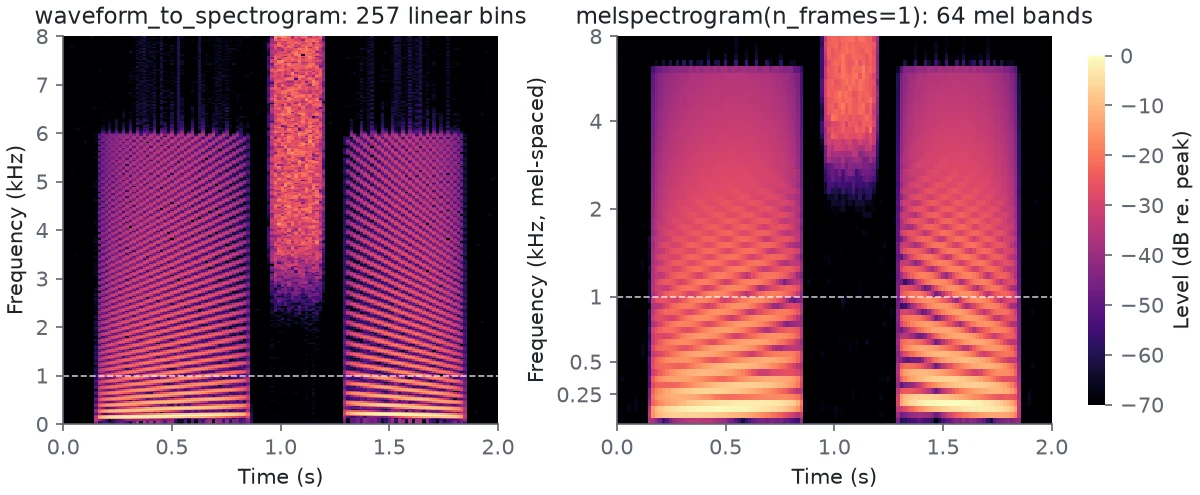
Two synthetic voiced syllables with a hiss between them, both pictures made
with n_fft=512 and hop_length=256 and each relative to its own peak. Below
the dashed line at 1 kHz lies an eighth of the linear picture and a third of
the mel one (21 of 64 bands). Above it the mel bands widen until harmonics
that stay separate on the left merge into one band.
- With the default
n_frames=5, row i is centred on frame i + 2, and there are four fewer rows than frames, 59 against 63 here. Per-frame labels on the same 512-sample grid line up aslabels[2:2 + len(feats)]. For one row per frame, taken_frames=1and add the neighbours withstack_context:kudio.stack_context(mel, 2)is(63, 320), the layout offeatswith padded rows at both edges. sourceis a file path or a NumPy array. A path is loaded mono, atsr=when it is given and at the file's own rate when it is not, so a two-second 44.1 kHz file gives 63 rows withsr=16000, n_frames=1and 173 without.- An array needs
sr=as a keyword (the second positional argument isn_mels); without it the call raisesFeatureError. - The defaults are
n_fft=1024andhop_length=512, not the spectrogram's 512 and 256. Pass both, as in the last line above, to get one row per row of theSTFT. The window stays Hann, librosa's default;melspectrogramhas no window argument. - A clip shorter than
n_framesframes gives an empty(0, n_mels * n_frames)array, not an error, andframe_windowsrefuses it withFeatureError. Drop such clips before they reach a training set. - The result is float32, like the spectrograms, so the two stack without a cast.
mfcc takes an array and its rate, no path, and
returns (1, mel_frames, n_mfcc); [0] drops the batch axis. Everything
except n_mfcc is librosa's default: Hann window, n_fft=2048, a 512-sample
hop and 128 mel bands. For MFCCs on the spectrogram's 256-sample grid, call
librosa directly and transpose:
librosa.feature.mfcc(y=y, sr=sr, n_mfcc=13, n_fft=512, hop_length=256).T is
(126, 13).
Context and windows
Three helpers turn a (frames, dim) feature matrix, a spectrogram or
mfcc(...)[0] alike, into what a model trains on, as float32.
stack_context and
frame_windows take one 2-D matrix;
ContextFrames takes a list of them, and
reads a 3-D array as one matrix per utterance.
stack_context
stack_context joins each frame with the
context frames before and after it: (frames, dim) becomes
(frames, dim * (2 * context + 1)), oldest frame first and the frame itself in
the middle. The edges are padded rather than dropped, so there is one output
row per input row and a prediction made from row t belongs to frame t.
frames = np.arange(12, dtype=np.float32).reshape(4, 3)
print(kudio.stack_context(frames, context=1))
print(kudio.stack_context(frames, context=1, pad="zero")[0])
[[ 0.  1.  2.  0.  1.  2.  3.  4.  5.]
 [ 0.  1.  2.  3.  4.  5.  6.  7.  8.]
 [ 3.  4.  5.  6.  7.  8.  9. 10. 11.]
 [ 6.  7.  8.  9. 10. 11.  9. 10. 11.]]
[0. 0. 0. 0. 1. 2. 3. 4. 5.]
pad="edge", the default, repeats the first and last frames; pad="zero"
pads with zeros. I made edge the default because a zero row is not silence in
any of these features: in log10 power, 0 is a power of 1 (silence is -31.3),
and after a Standardizer it is an average
frame. forward_backward= and STFT.forward(context=) always pad with zeros.
For edge padding, compute the spectrogram without context and call
stack_context on it.
ContextFrames
Stacking ±5 frames makes every row eleven frames wide, and a training set
stacked in advance takes eleven times the memory of its features.
ContextFrames keeps the features once and
stacks only the rows you ask for:
rng = np.random.default_rng(0)
utterances = [rng.standard_normal((n, 257)).astype(np.float32) for n in (300, 120, 410)]

bank = kudio.ContextFrames(utterances, context=5)
print(bank.shape)                                            # (830, 2827)
batch = bank[[0, 5, 829]]                                    # (3, 2827)

full = np.vstack([kudio.stack_context(u, 5) for u in utterances])
kept = sum(u.nbytes for u in utterances) / 2**20
print(f"{kept:.2f} MiB of features, {full.nbytes / 2**20:.2f} MiB stacked")
# 0.81 MiB of features, 8.95 MiB stacked
print(np.array_equal(batch, full[[0, 5, 829]]))              # True
Each utterance is padded at its own edges, so no window reaches into the next
one. Row i of the bank is row i of that np.vstack, so targets built with
np.vstack(targets) line up index for index. np.asarray(bank) builds the
whole stack, which on a real corpus is the memory you meant to save.
frame_windows
frame_windows cuts a matrix into
non-overlapping windows of n_frames: (frames, dim) becomes
(ceil(frames / n_frames), n_frames, dim), the shape a sequence model trains
on. The tail is padded, with copies of the last frame by default or zeros with
pad="zero", so a clip shorter than one window still gives one window.
windows = kudio.frame_windows(spec, n_frames=64)             # (2, 64, 257)
print(np.array_equal(windows.reshape(-1, 257)[:len(spec)], spec))   # True
The 126 frames fill two windows of 64 with two frames of padding, which a
model takes for real frames. Keep len(spec): the loss should skip those
frames, and the way back to audio needs them cut off again
(Back to a waveform).
Standardising with the training set's statistics
A Standardizer holds a mean and a
standard deviation for each feature dimension (each bin of a spectrogram),
fitted on the training features. Those two arrays are as much a part of the
trained model as its weights: a model given inputs on a different scale, or not
standardised at all, still answers, only wrongly. The block below reads a
training set of WAV files under data/train/; to follow along without one,
use training_clips = [y].
from pathlib import Path

training_clips = [kudio.file_load(p, sr=stft.sr)[0]
                  for p in sorted(Path("data/train").glob("*.wav"))]
train = np.vstack([stft.forward(c) for c in training_clips])    # (frames, 257)
std = kudio.Standardizer().fit(train)

x = std.transform(windows)            # (2, 64, 257) float32, the model's input
print(np.allclose(std.inverse(x), windows, atol=1e-4))          # True
fit takes a 2-D matrix only. Fit on the frames before they are cut into
windows, as above, so the tail padding stays out of the statistics;
transform and inverse
broadcast over any leading axes. Unlike norm=True, the statistics come from
the training set and are kept, so the recording level survives, relative to
the training data, and inverse undoes the scaling.
The standard deviation gets 1e-8 added, so a dimension that never changes in
the training set does not divide by zero, but a later difference of 0.1 in it
comes out as 1e7. Check (std.std < 1e-6).any() after fitting.
Saving the geometry and the statistics together
to_dict gives the STFT settings as a plain
dict, ready for JSON, and Standardizer.save writes the two arrays to a
.npz, creating the folder if needed. Store both next to the checkpoint and
load both with it:
import json

run = Path("runs/exp1")
run.mkdir(parents=True, exist_ok=True)
(run / "stft.json").write_text(json.dumps(stft.to_dict()))
std.save(run / "stats.npz")

# wherever the model is loaded again
stft = kudio.STFT.from_dict(json.loads((run / "stft.json").read_text()))
std = kudio.Standardizer.load(run / "stats.npz")

clip, _ = kudio.file_load("clip.wav", sr=stft.sr)   # any recording, at the model's rate
model_input = std.transform(stft.forward(clip))
save returns the path it wrote. numpy adds .npz to a name without it, so
std.save(run / "stats") writes and returns stats.npz, and
Standardizer.load(run / "stats") finds it. from_dict refuses a key it does
not know (ValueError: unknown STFT key(s): n_ftt, for a typo) and a missing
one, rather than fill it with a default the model was not trained on, so
write the file with to_dict(), not by hand.
The transforms never resample. For audio that arrives as an array with its own
rate, such as a recording, matches says
whether it needs resample first.
Back to a waveform
A model trained on standardised windows predicts standardised windows.
Standardizer.inverse, with the
statistics its targets were scaled with, turns a prediction back into log10
power, and STFT.inverse or
spectrogram_to_waveform turns
that into audio. A log-power spectrogram has no phase, so both take it from a
reference waveform, normally the noisy input the model has just cleaned up
(pairs like that come from Building a noisy dataset):
# x stands in for the model's prediction: standardised, in windows
cleaned = std.inverse(x).reshape(-1, stft.n_bins)[:len(spec)]   # (126, 257)
cleaned[:, stft.n_bins // 2:] -= 2.0  # bins from 4 kHz up, 20 dB down
out = stft.inverse(y, cleaned)        # magnitude from cleaned, phase from y
print(out.shape, out.dtype)           # (32000,) float32

change = stft.forward(out) - stft.forward(y)
print(round(float(change[:, stft.n_bins // 2:].mean()), 3))   # -1.987, in bels
- The rows have to be plain log10 power from the same geometry, one per frame
of the reference. A
norm=Truespectrogram runs without an error and comes back at the wrong level with a flattened spectrum. Context-stacked rows, or windows with their tail padding still on, raise aFeatureErrorthat gives both shapes, which is why the block above flattens the windows and cuts them back tolen(spec)rows. - The output has exactly
len(y)samples, and every one of them is rebuilt from the spectrogram, a last partial hop included. Unmodified, the round trip is off by at most 6e-8, on this clip and on its first second alone, which ends half-way through a hop.
save_spectrogram_as_wave does
the same from a file:
kudio.save_spectrogram_as_wave("enhanced.wav", "noisy.wav", cleaned) takes
the phase from noisy.wav at that file's own rate and writes 16-bit PCM,
clipped at full scale rather than wrapped around. It takes the geometry as
loose arguments with the default STFT's values; for any other, call
stft.inverse and save_wave.
When you need the phase itself, for a complex mask or a gain on the complex
spectrum, use analyse and
synthesise. The spectral methods on
Denoising run on this pair, with their own framing: a Hann
window and a hop of n_fft // 4.
X = stft.analyse(y)                   # (126, 257) complex64
gain = np.ones(stft.n_bins, np.float32)
gain[stft.n_bins // 2:] = 0.1         # the same 20 dB, on the complex spectrum
out = stft.synthesise(X * gain, length=len(y))

# a log-power spectrogram with the phase of y, every sample rebuilt
out = stft.synthesise(np.sqrt(10.0 ** cleaned) * np.exp(1j * np.angle(X)),
                      length=len(y))
Pass length=len(y). Without it synthesise stops at the last whole hop,
15872 samples into a one-second clip.
Many files at once
file_to_spectrogram loads a file
mono and returns what
waveform_to_spectrogram would,
with the Hamming window unless window= names another. Two more helpers run
over a list of files and stack the results:
files = sorted(Path("data/clean").glob("*.wav"))   # three 16 kHz files: 2.0, 1.5 and 1.0 s

rows = kudio.logspec_from_files(files, sequence=False, forward_backward=0,
                                norm=False)                          # (283, 257)
seqs = kudio.logspec_from_files(files, sequence=True, forward_backward=0,
                                norm=False, desired_samples=sr)      # (3, 63, 257)
coeffs = kudio.mfcc_from_files(files, n_mfcc=13, desired_samples=sr)    # (3, 32, 13)
- A 3-D result, from
sequence=Trueinlogspec_from_filesor frommfcc_from_files, needs every file to give the same number of frames, or numpy'svstackraisesValueError.desired_samplescuts each file to that many samples, which evens them out only if none is shorter. - In
mfcc_from_files,desired_lengthis a whole number of seconds; inwaveform_to_spectrogramandfile_to_spectrogramit is samples. - Each file is read at its own rate, so in a folder that mixes 8 and 16 kHz a frame and a bin mean different things from file to file. Convert the folder first (Audio files).
Where the parameters are
The STFT and feature functions and classes, with their signatures and
defaults, are in the API reference under
STFT and features. Code that still calls w2s or
wav2mel is covered on Migrating from v2.