Measuring quality
Every metric on this page scores a processed recording against the clean recording it came from. When there is no clean recording, the checks on Inspecting a recording still work, DNSMOS among them; everything here needs the reference.
Four of them, SNR, SI-SDR, segmental SNR and SDI, also compare sample i of one signal with sample i of the other. One sample of delay takes a perfect copy down to +11.9 dB of SI-SDR, a little above what the denoiser on this page scores with no delay at all (+11.7 dB), and nothing in the score says that a delay is what happened. SDR forgives a late start, STOI about a millisecond, and PESQ lines the pair up itself, but none of them reports the delay either. So lining the pair up comes before choosing a metric.
A first score
The examples on this page share one synthetic clip: two phrases of a harmonic
tone over room tone, with a pause between them, mixed with white noise at
5 dB SNR by add_noise_snr and
denoised by spectral_enhance
(see Denoising). Everything is seeded, so apart from the
figures above 100 dB, which are round-off, the numbers below should come out
the same on your machine.
import numpy as np
import kudio

sr = 16000
rng = np.random.default_rng(0)

def burst(seconds, f0):
    """A harmonic tone that swells four times a second, like syllables."""
    t = np.arange(int(seconds * sr)) / sr
    tone = sum(np.sin(2 * np.pi * f0 * k * t) / k for k in range(1, 12))
    return tone * (0.5 + 0.5 * np.sin(2 * np.pi * 4 * t)) / 6

clean = 0.01 * rng.standard_normal(4 * sr)       # room tone
clean[8000:24000] += burst(1.0, 120)             # two phrases with
clean[32000:52800] += burst(1.3, 150)            # a pause between
clean = clean.astype(np.float32)

noise = rng.standard_normal(4 * sr).astype(np.float32)
noisy = kudio.add_noise_snr(clean, noise, snr_db=5, seed=0)
enhanced = kudio.spectral_enhance(noisy, sr)     # log-MMSE
score takes the reference first and the
signal being judged second, runs the metrics by name and returns a dict. With
no list it runs every metric that can run on this machine, which here is all
of them but PESQ:
snr, si_sdr, segsnr and sdi are plain numpy and need nothing beyond
kudio. Each is also a function of its own with the same argument order:
snr, si_sdr,
segmental_snr and
sdi. stoi, estoi and sdr need
kudio[eval]; pesq needs kudio[pesq] and a rate of 8 or 16 kHz. Name a
metric that cannot run and score raises instead of leaving it out: an
unknown name is a ValueError, a missing package a
DependencyError that names the extra to
install.
Getting started has why mir_eval is pinned below 0.9.
check_metrics_install returns
(pesq_ok, stoi_ok, sdr_ok), which back-ends this machine has, and logs an
install hint for each missing one once per process.
AudioEvaluate and eval_metrics call it too, so configure logging before
the first of them, or that one hint goes nowhere.
eval_metrics is the fixed-shape
version, for code that unpacks three values: always (pesq, stoi, sdr), with
None for any of them that is not installed, cannot run on the pair or fails
on it. Unlike everything else on this page, it takes the rate first:
kudio.eval_metrics(sr, clean, noisy) returns
(None, 0.6065905900244255, 5.010295956402773) here.
Line the pair up first
Here is the clip scored against itself, and the log-MMSE output scored against the clip, each starting a few samples late. Both keep their length, so there is nothing for a length check to notice:
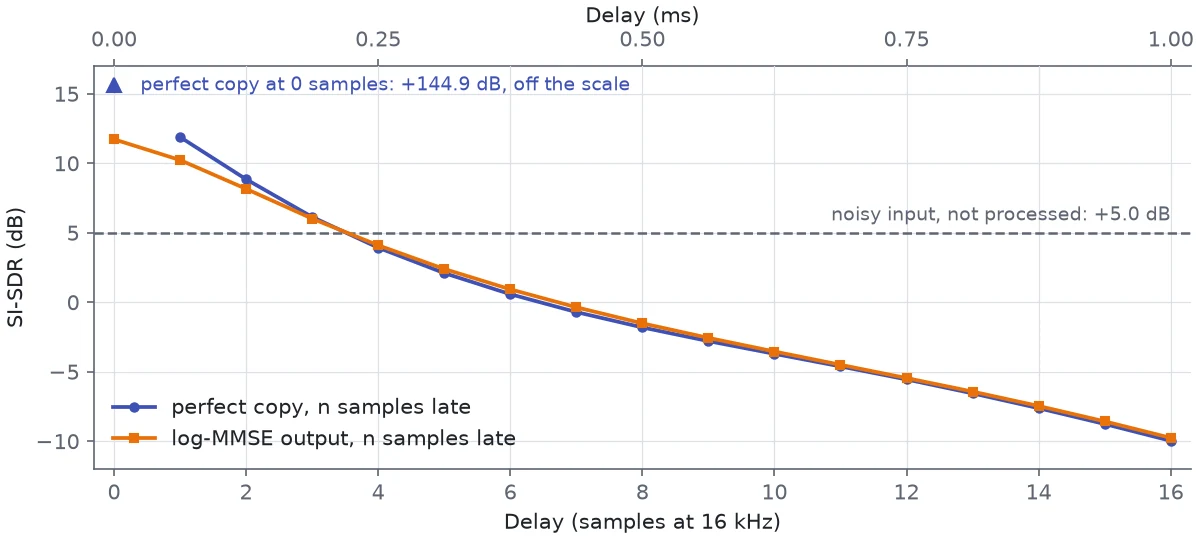
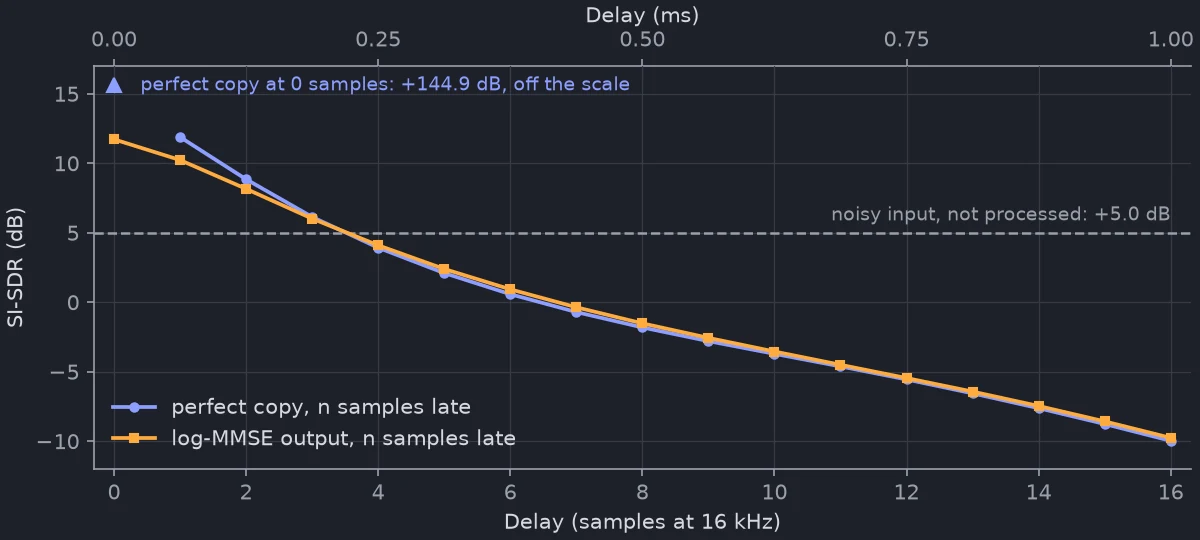
Four samples late, a quarter of a millisecond at 16 kHz, the copy scores +3.9 dB and the denoised take +4.1 dB, both below the noisy input that was never processed at all (+5.0 dB). From three samples on, the two curves stay within 0.4 dB of each other: the delay decides the score and the denoising hardly shows in it. Read without knowing about the delay, the number says the denoiser does worse than nothing.
Delays come from ordinary places: a causal filter, a resampler, a model that pads its input frames, a take played through a speaker and recorded again. When the processed file comes back longer than the clean one, the length check warns. When something trimmed it back to the input's length, nothing does.
Finding the delay
find_delay measures the delay to the nearest
sample by cross-correlation, and align returns the
pair trimmed to the part they share:
processed = np.concatenate([np.zeros(128, np.float32), enhanced])  # 8 ms late

found = kudio.find_delay(clean, processed, sr)
print(found)

a, b = kudio.align(clean, processed, sr)
print(len(a), len(b), round(kudio.si_sdr(a, b), 2))
Scored as it sits, the same pair gets -7.97 dB, plus a warning that the lengths differ.
In the Alignment that find_delay returns, a
positive delay means the second signal starts later. The correlation is
normalised over the overlap only, so a real match that shares one second of a
long file still scores high. A chain with a fixed latency needs measuring only
once, on a loud passage, and
Alignment.apply trims any later pair at
the delay already found:
other = kudio.add_noise_snr(clean, noise, snr_db=10, seed=0)
other_out = np.concatenate([np.zeros(128, np.float32),
                            kudio.spectral_enhance(other, sr)])

a, b = found.apply(clean, other_out)     # the 128 samples measured above
print(round(kudio.si_sdr(a, b), 2))
The wrong file still gets a delay
Cross-correlation always has a maximum, so find_delay returns a delay for any
two signals, including two that have nothing in common. The correlation is
what tells the cases apart, and align refuses below
MIN_CORRELATION, which is 0.5:
leads by 5873 samples (367.1 ms), correlation 0.016, polarity inverted
kudio.exceptions.FeatureError: these do not look like the same recording: best correlation 0.016 at -5873 samples, below 0.5. Aligning them would put a number on two unrelated signals; pass min_correlation=0 to do it anyway.
At a correlation of 0.016 the polarity note means nothing either.
I set the threshold low on purpose. The denoised take above sits at 0.968; the threshold is there to catch somebody picking the wrong file, not to grade the processing.
Clearing it does not prove the lag is the one you meant, either. Speech
repeats itself, and an unbounded search over a long file can find a better
match half a minute away. When you know the delay is small, bound the search
with max_seconds=, set above the largest delay you expect. What comes back
is the best lag inside the bound, and that can still clear 0.5 when the real
lag lies outside it.
Polarity
An inverted copy correlates at -1. It is the same take, and something in the
chain flipped it. I treat that as a finding rather than something to correct
on the way past: find_delay reports polarity inverted, and align logs a
warning, seen once logging is configured, and returns the pair as it is.
SI-SDR does not see the flip and SNR does: lined up with -processed, the
pair above still scores 11.72 dB of SI-SDR, and its SNR drops to -5.77 dB.
Mono, at one rate
find_delay and align take mono audio. A stereo array is refused rather
than mixed down, because which channel led is a question of its own. The
metrics refuse one too, with a ValueError, rather than score both channels
as one signal; score a channel at a time, or mix down first. Both signals also
have to be at the one sr you pass. find_delay cannot tell when they are
not, so bring them together with resample first.
For a single pair of files, kudio align clean.wav processed.wav --metrics
prints the delay and the SI-SDR before and after lining them up, and exits 1
when the two do not look like the same recording (see
Command line).
When the lengths differ
snr, si_sdr, segmental_snr and sdi cut
both signals to the length they share, and so do score and eval_metrics
for every metric they run. The tail of the longer one is never compared, so a
difference in length is warned about on every call:
UserWarning: ref is 64000 samples and deg 60000: only the first 60000 samples are scored and the rest is ignored. Use kudio.align if the short one is delayed rather than just short, or trim the pair yourself to say which part you meant.
Python shows an identical warning from one line only once, so in a loop over
pairs all cut by the same amount only the first warns;
warnings.simplefilter("always") shows each.
Once more than half of the longer signal would go unmeasured, the pair is refused. Without that limit, the first second of the clip would score as a perfect copy of all four seconds, because the three it lacks are never looked at:
ValueError: ref is 64000 samples and deg 16000: comparing them leaves 48000 of the longer one's 64000 samples unmeasured (75.0%), past the 50% limit, so the score would be about the overlap rather than about the pair. Check that these two are the same utterance, line them up with kudio.align, or raise kudio.core.evaluator.MAX_LENGTH_MISMATCH to score them as they sit.
The limit is
MAX_LENGTH_MISMATCH, 0.5 of the
longer signal. A real pipeline loses a window or two at the tail, or a sample
to a resampler's rounding, and half the file is far beyond that. The constant
is read on every call, so a pair that really is that lopsided can be scored
after kudio.core.evaluator.MAX_LENGTH_MISMATCH = 0.8. It has to be set on
that module: there is no kudio.MAX_LENGTH_MISMATCH, and assigning one
changes nothing.
AudioEvaluate checks every pair of
files it reads the same way, with both file names in the message, and so
does pesq called on its own. The refusal is a
plain ValueError, so an except for
KudioError around a batch will not catch it.
What each metric sees
The same clip, damaged six ways, scored by six metrics:
| Damage | snr |
si_sdr |
segsnr |
sdi |
stoi |
sdr |
|---|---|---|---|---|---|---|
| noise, 5 dB SNR | 5.0 | 5.0 | -2.1 | 0.32 | 0.61 | 5.0 |
| half the gain | 6.0 | 138.9 | 6.0 | 0.25 | 1.00 | 283.0 |
| polarity flipped | -6.0 | 144.9 | -6.0 | 4.00 | 1.00 | 283.0 |
| low-pass, 2 kHz | 18.2 | 18.2 | 10.3 | 0.02 | 0.93 | 24.9 |
| 1 sample late | 12.1 | 11.9 | 4.6 | 0.06 | 1.00 | 91.3 |
| 1 ms late | -1.4 | -10.0 | -2.2 | 1.40 | 0.99 | 53.6 |
The script behind the table
def late(y, n):
    return np.concatenate([np.zeros(n, np.float32), y])[:len(y)]

cases = {
    "noise, 5 dB SNR": noisy,
    "half the gain": 0.5 * clean,
    "polarity flipped": -clean,
    "low-pass, 2 kHz": kudio.lowpass(clean, sr, cutoff=2000),
    "1 sample late": late(clean, 1),
    "1 ms late": late(clean, 16),
}
names = ["snr", "si_sdr", "segsnr", "sdi", "stoi", "sdr"]
for case, deg in cases.items():
    s = kudio.score(clean, deg, sr, names)
    print(f"| {case} | {s['snr']:.1f} | {s['si_sdr']:.1f} | {s['segsnr']:.1f} "
          f"| {s['sdi']:.2f} | {s['stoi']:.2f} | {s['sdr']:.1f} |")
Anything above 100 dB means the metric found nothing wrong. In snr and
si_sdr the figure comes from a 1e-12 guard against dividing by zero, so it
moves with the clip's energy, and 138.9 and 144.9 are the same verdict. The
283.0 of sdr is round-off left in mir_eval's residual.
snr- Charges for everything: noise, gain, polarity, filtering, delay. A perfect copy at half the level scores 6.0 dB. Use it when the level is part of what you are judging.
si_sdr- Removes the mean of both signals and the best-fitting gain before comparing, so a level change or a flipped polarity costs nothing while filtering and delay still do.1 It is the number I look at first for a denoiser, which should not lose points for coming back quieter.
segsnr,segmental_snr- SNR per frame, each frame held to [-10, 35] dB, then averaged. Through
scorethe frames are always 512 samples with a hop of 256, which is 32 ms at 16 kHz and 10.7 ms at 48 kHz;segmental_snrtakesframe_length=andhop_length=to change them. Pauses count as much as speech: in the 5 dB mix, 116 of the 249 frames sit at the -10 dB floor, most of them in the room tone around the phrases, and that pulls the average to -2.1 dB. A perfect copy scores exactly 35.0, and a clip shorter than one frame scores NaN. sdisum((ref - deg)**2) / sum(ref**2), which is SNR on a linear scale,10 ** (-snr / 10): 0 is a perfect copy, 1 is as much error as there is speech, and lower is better. It is taken on the whole output, so leftover noise counts as error along with distortion, and the unprocessed 5 dB mix scores 0.32. The speech-distortion index of the noise-reduction literature2 passes the clean speech through the filter on its own, which leaves the noise out, and an untouched input scores 0 there. Comparesdionly with figures computed the way it is.stoi,estoi- Short-time objective intelligibility,3 through
pystoi. It compares short-time envelopes in one-third-octave bands after resampling both signals to 10 kHz and dropping silent frames, so gain, polarity and a millisecond of delay barely move it, while noise does. It forgives little more than that: 5 ms late scores 0.85 and 10 ms 0.63, about what 5 dB of noise costs (0.61).estoi, the extended version, gives 0.31 on the 5 dB mix where STOI gives 0.61. A perfect copy scores 1 on both, and higher is better. pystoi needs about 0.4 s of audio left once the silent frames are gone. Below that it hands back 0.00001 even for a perfect copy, a placeholder rather than a score, so kudio scores such a clip NaN with a warning, andAudioEvaluateleaves it out of the mean. sdr- The SDR of BSS Eval,4 through
mir_eval. It fits the best 512-tap filter from the reference to the output and counts as distortion only what that filter cannot produce. Gain, polarity, a low-pass and a late start of up to 511 samples are partly or fully forgiven, so one sample late scores 91.3 dB. The filter is causal, and an output that starts early gets none of that: one sample early scores 15.2 dB. Compare it with SDR figures computed the same way, never with SI-SDR.
Different metrics also disagree about the same denoiser. On this clip, log-MMSE gains 6.8 dB of SI-SDR (4.97 to 11.72) while STOI stays where it was (0.607 to 0.601), and ESTOI drops, from 0.305 to 0.276.
PESQ: say which one
PESQ comes in two standards and two scales, and they give different numbers
for the same file. ITU-T P.862 scores narrowband speech at 8 or 16 kHz;
P.862.2 scores wideband speech at 16 kHz only. P.862 can be reported raw, on
-0.5 to 4.5, or mapped to MOS-LQO through P.862.1. P.862.2 defines only the
MOS-LQO. pesq takes the bandwidth as mode=
and the scale as scale= rather than picking one without telling you, and
score, eval_metrics and AudioEvaluate pass them on as pesq_mode= and
pesq_scale=:
mode |
scale |
at 8 kHz | at 16 kHz |
|---|---|---|---|
'auto' (default) |
'lqo' (default) |
P.862, MOS-LQO | P.862.2, MOS-LQO |
'nb' |
'lqo' |
P.862, MOS-LQO | P.862, MOS-LQO |
'wb' |
'lqo' |
refused | P.862.2, MOS-LQO |
'auto' or 'nb' |
'raw' |
P.862, raw | P.862, raw |
'wb' |
'raw' |
refused | refused |
Any other rate raises a ValueError that says to resample first.
A paper that just says "PESQ" may mean the raw P.862 score or a MOS-LQO,
narrowband or wideband, so find out which before setting your numbers beside
it. When a number goes into a table, I pass both arguments and name the scale
next to it. Both lines need the pesq package, which compiles from source
(Getting started has what that takes):
kudio.pesq(clean, enhanced, 16000)                          # P.862.2 MOS-LQO
kudio.pesq(clean, enhanced, 16000, mode="nb", scale="raw")  # raw P.862
The pesq package returns MOS-LQO, and kudio takes the raw score back
through the P.862.1 mapping; the formula is in the reference for pesq. The
two scales are not a constant apart. A raw 1.0 is a narrowband MOS-LQO of
1.16, 2.0 is 1.63, 3.0 is 2.82 and 4.0 is 4.15. They cross at raw 1.22 and
3.37, and between the two the raw score is the higher, so a narrowband
MOS-LQO set against a paper's raw PESQ makes a method look worse than it is.
P.862.2 maps with coefficients of its own, so none of this converts a
wideband score.
A whole test set
AudioEvaluate scores lists of files:
the clean references, the noisy inputs, and one list per method, paired by
position. clean_files[i], noisy_files[i] and each method's i-th file
have to be the same utterance. It reports PESQ, STOI and SDR, whichever are
installed, and needs pandas (kudio[data]) for its tables.
files = {"clean": [], "noisy": [], "logmmse": [], "wiener": []}
snr_of = {}
for snr_db in (0, 5, 10):
    mix = kudio.add_noise_snr(clean, noise, snr_db=snr_db, seed=0)
    takes = {"clean": clean, "noisy": mix,
             "logmmse": kudio.spectral_enhance(mix, sr, "logmmse"),
             "wiener": kudio.spectral_enhance(mix, sr, "wiener")}
    for name, wave in takes.items():
        path = f"eval/{name}_{snr_db}dB.wav"
        kudio.save_wave(path, wave, sr)          # creates eval/
        files[name].append(path)
    snr_of[files["noisy"][-1]] = snr_db

ev = kudio.AudioEvaluate(files["clean"], files["noisy"],
                         pesq_mode="nb", pesq_scale="raw")
ev.eval("logmmse", files["logmmse"])
ev.eval("wiener", files["wiener"])
print(ev.get_df())
The first eval also scores the noisy files once, against the same
references, and get_df puts
them last as the Baseline row. Each value is a mean over the files, rounded
to four decimals. A PESQ column joins the table when the pesq package is
installed; this run had none. Each pass also draws a tqdm bar on stderr,
which Getting started shows how to turn off.
When a metric fails on one file, that file gets NaN with a logged warning and
is left out of the mean rather than taking the whole column down. A file that
cannot be scored at all, unreadable, at a different rate from its reference
or past the length limit, gets NaN in every column and a warning naming it,
and the rest of the list is still scored. The Baseline row is averaged over
the files the last method scored, so for a method with NaN files, compare it
with Baseline in per_file rather than in this table.
per_file has one row per
method and file, Baseline included, with the clean, noisy and scored
file paths beside the scores, so the results can be broken down by anything
you know about each file:
table = ev.per_file()
table["snr_db"] = table["noisy"].map(snr_of)
print(table.pivot(index="snr_db", columns="method", values="SDR").round(2))
Wiener leads at 0 and 5 dB, and log-MMSE at 10 dB. For a dataset built with
the Synthesizer, join on the noisy column
with its manifest, which records the noise, SNR, room and link of every
mixture (Building a noisy dataset). The join compares path
strings, so build the file lists from the manifest itself, with
[p.noisy for p in pairs] after
load_manifest, rather than from a fresh
folder listing. Without pandas, ev.rows holds the method rows as plain
dicts. There is no SI-SDR column; for that, loop over the pairs with score.
To try kudio's own denoising methods side by side on one recording, with
SI-SDR and the same PESQ options, see
compare_enhancers on
Denoising. Every parameter of the functions on this page is
in the API reference under Metrics and alignment.
-
J. Le Roux, S. Wisdom, H. Erdogan and J. R. Hershey, "SDR – half-baked or well done?", ICASSP 2019. ↩
-
J. Chen, J. Benesty, Y. Huang and S. Doclo, "New insights into the noise reduction Wiener filter", IEEE Trans. Audio, Speech, Lang. Process. 14(4), 2006. ↩
-
C. H. Taal, R. C. Hendriks, R. Heusdens and J. Jensen, "An algorithm for intelligibility prediction of time-frequency weighted noisy speech", IEEE Trans. Audio, Speech, Lang. Process., 2011. ESTOI: J. Jensen and C. H. Taal, "An algorithm for predicting the intelligibility of speech masked by modulated noise maskers", IEEE/ACM Trans. Audio, Speech, Lang. Process., 2016. ↩
-
E. Vincent, R. Gribonval and C. Févotte, "Performance measurement in blind audio source separation", IEEE Trans. Audio, Speech, Lang. Process. 14(4), 2006. ↩