Inspecting a recording
Every score on Measuring quality compares a processed clip with a clean reference. A synthetic dataset has both; a recording from the field has only itself, and that is usually the one you need to judge. Score a denoised field recording against the noisy original and you measure how much the denoiser changed it, not whether it got better. So first, the questions a file can answer on its own:
| Question | Reach for | Needs |
|---|---|---|
| What is this file? | audio_info |
the core install |
| Is it technically sound? | audio_report |
the core install |
| How loud does it sound, and where did the level move? | loudness and the functions beside it |
the core install |
| What would a listener say about it? | dnsmos |
kudio[dnsmos] and model weights kudio does not ship |
The examples share one synthetic take, so they run anywhere: a 140 Hz voice with harmonics up to 7.6 kHz, switched on and off to leave pauses, over a hiss at -54 dBFS. The last line asks the file what it is.
import numpy as np
import kudio

sr = 16000
rng = np.random.default_rng(0)
t = np.arange(20 * sr) / sr
voice = sum(np.cos(2 * np.pi * 140 * k * t) / k for k in range(1, 55))
words = np.sin(2 * np.pi * 0.7 * t) > -0.3          # talk, pause, talk, ...
take = 0.05 * voice * words + 0.002 * rng.standard_normal(t.size)
kudio.save_wave("take.wav", take, sr)
print(kudio.audio_info("take.wav"))
audio_info reads the rate, channels, length and
encoding from the header and scans the samples for the peak, a block at a
time, without loading the file. Audio files has the rest of
it, including how to skip the scan on a large corpus.
A health check with no reference
audio_report measures what can be measured
without a clean twin and returns an
AudioReport, whose
problems() puts the findings into
plain words. An empty list is good news.
y, sr = kudio.file_load("take.wav")
report = kudio.audio_report(y, sr)
print(report)
print(report.problems())
It takes mono audio and raises a FeatureError
on a multi-channel array. The default file_load averages the channels, which
can hide a fault in one of them, so check a stereo file a channel at a time:
load it with mono=False and report y[:, 0] and y[:, 1]. Frames are 30 ms
at a 15 ms hop, and the thresholds are fixed, not parameters:
| Field | Measures | Flagged when |
|---|---|---|
peak_dbfs |
the loudest sample, in dBFS | over 0, over -0.5 or under -30 |
clipped_samples, clipped_ratio |
samples in a flat run at full scale | any |
dc_offset |
the mean sample value | size over 0.01 |
silence_ratio |
share of frames more than 40 dB below the 95th-percentile frame | over 0.6 |
noise_floor_dbfs |
level of the 10th-percentile frame | never |
estimated_snr_db |
95th-percentile frame level minus the 10th | under 10 dB |
bandwidth_hz, band_limited |
highest frequency still carrying content | under 0.9 of Nyquist |
lufs, rms_dbfs |
integrated loudness (nan under 0.4 s) and plain RMS |
never |
non_finite_samples |
samples that are NaN or inf | any |
The three peak limits mean past full scale, one gain stage from clipping, and
too little of the bit depth in use. A peak of -inf (digital silence) and any
non-finite sample are each reported on their own, with nothing else beside them.
Clipping
A loud sample is not a clipped one. Float audio amplified past 1.0 still traces its waveform; the damage happens when it is written to an integer format. Clipping is information already destroyed, and it looks like a plateau, so the report counts a sample as clipped only inside a run of at least three samples at 0.999 of full scale or more that vary by no more than 1e-4. A sample or two touching 1.0 is not counted; it shows up as a peak right against the ceiling.
hot = 8 * take                              # float: louder, but intact
for clip in (hot, np.clip(hot, -1.0, 1.0)):
    for problem in kudio.audio_report(clip, sr).problems():
        print(problem)
peaks at +5.5 dBFS, past full scale — it will clip the moment it is written to an integer format
3321 samples clipped (1.04% of the clip) — the recording was already too hot; no processing gets that back
The run rule has two blind spots. A peaky voice pushed past full scale clips a
sample or two per pitch period: the take normalised to -14 LUFS and written as
PCM_16 loses 2618 samples that way, and the report on the file says only
that it peaks at -0.0 dBFS. A clipped recording turned down afterwards, even by
1 dB, has its plateaus below 0.999 and is not reported at all. Run the report
before writing, while the samples past 1.0 are still there to see; the second
case needs a look at the waveform.
Upsampled and band-limited files
The fault that does the quietest damage to a dataset is a 16 kHz file holding 8 kHz audio: resampled up at some point, nothing above 4 kHz, and treated as wideband by everything downstream. A recording made at its stated rate usually has a noise floor spread over the whole band, so its spectrum reaches Nyquist. Upsampled audio has nothing above the old Nyquist at all.
So the report averages the spectrum over 1024-sample Hann frames and takes the highest frequency still within 50 dB of the strongest one. Below 0.9 of Nyquist the clip counts as band-limited. When twice that frequency is within 15 % of a common rate (8, 11.025, 16, 22.05, 32, 44.1 or 48 kHz), the finding names it as the rate the file was upsampled from; otherwise it names the frequency itself, "band-limited to about 3219 Hz".
narrow = kudio.resample(kudio.resample(take, sr, 8000), 8000, sr)
for problem in kudio.audio_report(narrow, sr).problems():
    print(problem)
content stops at 3797 Hz although the file claims 16000 Hz — it was very likely upsampled from 8000 Hz, and the extra rate is empty
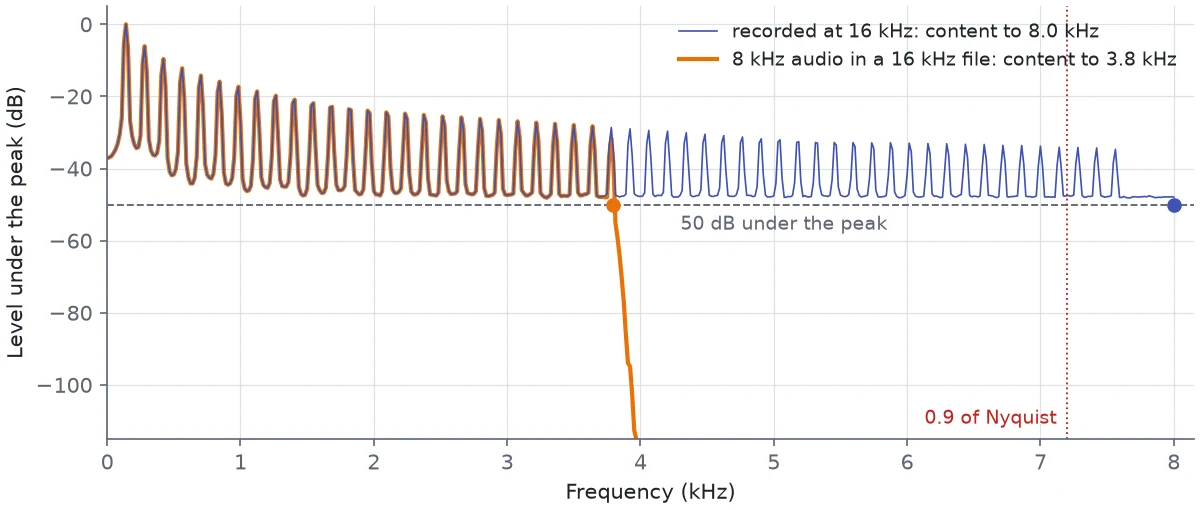
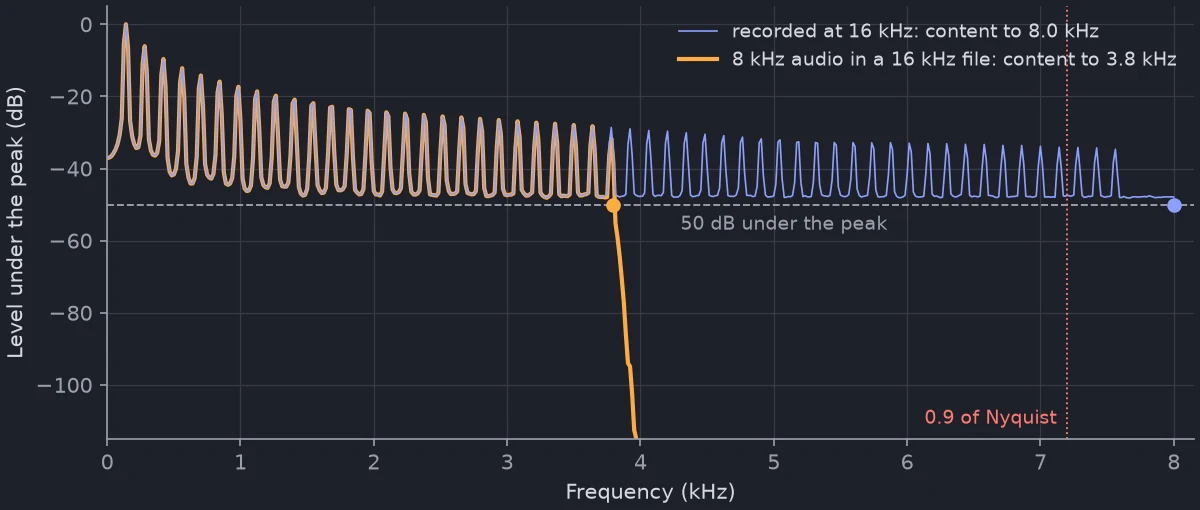
telephone on
Rooms and channels makes such a file on purpose, and the
report reads it the same way. The check makes two assumptions. The content has
to be broadband, as speech is: a pure 220 Hz tone is reported as band-limited
and as noisy, which is correct arithmetic and no use to anybody. And the noise
floor has to sit within 50 dB of the strongest part of the spectrum. A clean
recording with a quieter hiss and a quiet top octave stops short of 0.9 of
Nyquist with nothing resampled: the take's voice with its harmonics falling as
1 / k**1.5 instead of 1 / k, over hiss at -66 dBFS, is reported as
stopping at 6578 Hz. On a quiet, clean file, take the finding as a reason to
look at the spectrum, not as proof.
When one fault changes another's reading
The measurements all come from the same samples, so one fault could move a number that belongs to another. A DC offset does not: the frame levels are measured with the clip's mean taken out, so an offset is reported as an offset and the floor is read from what is left. Clipping does. It spreads energy up the spectrum, past the 50 dB line, so a clipped file looks wideband whatever its history:
for label, clip in [("as is", narrow),
                    ("+0.03 DC", narrow + 0.03),
                    ("clipped", np.clip(8 * narrow, -1.0, 1.0))]:
    r = kudio.audio_report(clip, sr)
    print(f"{label:10}  floor {r.noise_floor_dbfs:6.1f} dBFS  "
          f"SNR~{r.estimated_snr_db:3.0f} dB  "
          f"bandwidth {r.bandwidth_hz:4.0f} Hz  band-limited {r.band_limited}")
as is       floor  -57.5 dBFS  SNR~ 31 dB  bandwidth 3797 Hz  band-limited True
+0.03 DC    floor  -57.5 dBFS  SNR~ 31 dB  bandwidth 3797 Hz  band-limited True
clipped     floor  -37.9 dBFS  SNR~ 28 dB  bandwidth 7984 Hz  band-limited False
With the offset in, problems() adds the DC finding and nothing else; take the
offset out with remove_dc anyway, since it
wastes headroom. The clipped copy loses the finding that it was upsampled from
8 kHz, so read nothing into the bandwidth of a clipped file.
Corrupt samples
A clip with NaN or inf in it is measured, not refused: checking a corpus is exactly when you want to hear about every broken file, not stop at the first.
broken = take.copy()
broken[5000:5010] = np.nan
for problem in kudio.audio_report(broken, sr).problems():
    print(problem)
10 samples are not finite (NaN or inf) — the clip is corrupt, not quiet, and every measurement here is meaningless. Repair it or drop it from the set
It comes first and alone, because the other checks cannot be relied on to
notice: a comparison against NaN is false whichever way round it is written.
Read problems(), not the fields; beside the count, this report still gives
an estimated SNR of 28 dB. The loudness functions check for themselves, so a
corrupt clip never measures -inf, the reading for silence:
loudness and
true_peak return nan with a warning, a
curve from loudness_over_time
reads "171 of 171 window(s) unmeasurable", and normalize_lufs and
match_loudness raise FeatureError rather than scale by a level that is not
there. Loading, audio_info and save_wave each handle such a file their own
way (Audio files).
What the numbers cannot tell you
The SNR estimate needs pauses with noise in them: it reads the floor off the 10th-percentile frame, which works only when a tenth of the frames hold nothing but noise. While the voice is on, the take's hiss sits 27 dB under it, and the report says 28. Averaged over the whole file, pauses included, the way a mix SNR is counted, the take is at 24.8 dB, which is why the report reads several dB above the SNR a file was mixed at (Getting started has an example). Without the right kind of pause, the quietest frames are speech:
steady = 0.05 * voice + 0.002 * rng.standard_normal(t.size)   # never pauses
clean = 0.05 * voice * words                    # pauses of exact zeros, no hiss
for name, clip in [("no pauses", steady), ("no hiss", clean)]:
    print(f"{name:10} SNR~{kudio.audio_report(clip, sr).estimated_snr_db:.1f} dB")
The first is reported as "estimated SNR around 1 dB", and the finding is wrong:
the quietest tenth of its frames are speech. Treat a low estimate on a clip
without noisy pauses as unknown rather than bad. The second clip is clean and
is read as clean: when at least a tenth of the frames are exact zeros, the
floor is digital silence, -inf dBFS, and nothing is listed. Speech activity and pitch finds where the speech is, and
Denoising takes a real hiss out. An empty list is only a
technical verdict, too: a clip can pass everything here and still sound poor,
which is what DNSMOS is for.
A folder at a time
A file soundfile cannot open raises
AudioIOError, and an empty one a
FeatureError. Catch both, or the sweep stops at the first broken file:
from pathlib import Path

for path in sorted(Path("corpus").rglob("*.wav")):
    try:
        y, sr = kudio.file_load(path)
        problems = kudio.audio_report(y, sr).problems()
    except (kudio.AudioIOError, kudio.FeatureError) as e:
        problems = [f"not measured: {e}"]
    for problem in problems:
        print(f"{path.as_posix()}: {problem}")
How loud it sounds
The peak says little about how loud a clip sounds, since one stray click sets
it (Editing and effects shows the damage).
loudness measures what a listener hears, to
ITU-R BS.1770-4, as gated integrated loudness in LUFS:
- K-weight the signal: a high shelf worth +4 dB from about 5 kHz up, for the effect of the head, and a high pass about 3 dB down at 60 Hz, for rumble.
- Take the mean square over 400 ms blocks, a new block every 100 ms.
- Drop the blocks below -70 LUFS, then those more than 10 LU below the level of what is left. These are the absolute and relative gates.
- Average the rest in the power domain.
The gates are what make the number usable. Plain RMS falls every time somebody stops talking and the room tone takes over; gated loudness does not:
padded = np.concatenate([take, 0.002 * rng.standard_normal(10 * sr)])  # room tone
for clip in (take, padded):
    rms = 10 * np.log10(np.mean(clip ** 2))
    print(f"RMS {rms:.1f} dBFS, loudness {kudio.loudness(clip, sr):.1f} LUFS")
The room tone measures -51.3 LUFS on its own, far above the -70 LUFS absolute gate, so it is the relative gate that leaves it out.
The standard publishes its filters at 48 kHz only, and the textbook equations
do not reproduce them, so kudio carries the published ones to other rates
through a prewarped bilinear transform, at most 0.07 dB off the 48 kHz response
at 16 kHz and 0.29 dB at 8 kHz. A full-scale 1 kHz sine, -3.01 LUFS in the
standard, reads -3.004 at 48 kHz, -3.05 at 16 kHz and -3.21 at 8 kHz. With
pyloudnorm installed (the [check] extra), kudio's tests hold it to that
independent meter within 0.1 LU at 8, 16, 44.1 and 48 kHz.
Multi-channel audio goes in channels last, (samples, channels): up to five
channels, weighted 1.0, 1.0, 1.0, 1.41 and 1.41 for left, right, centre and the
two surrounds. There is no slot for an LFE channel, so a six-channel file is
refused. Load a stereo file with mono=False before measuring it: the default
load averages the channels, which reads 3.01 LU low when the two are the same
and 6.02 LU low when only one carries the signal. A clip shorter than one
400 ms block raises a FeatureError that points at block_size=; a smaller
block gives a number, but not a BS.1770 one.
Normalising to a target
normalize_lufs applies the one gain
that brings a clip to a target, -23 LUFS by default (EBU R 128), and returns
silence unchanged. It does nothing else. Samples the gain pushes past full
scale come back past 1.0, not limited, because limiting them would change the
loudness you just asked for:
loud = kudio.normalize_lufs(take, sr, lufs=-14.0)
print(f"{kudio.loudness(loud, sr):.1f} LUFS, peak {np.max(np.abs(loud)):.2f}")
It raises a UserWarning when that happens, which Python shows without any
setup.
Save such a clip with subtype="FLOAT" or aim lower, since as PCM_16 it
clips in the way the report barely notices (Clipping). The
warning is about samples only; the true peak between them can be
higher still. convert_folder with
lufs=-23.0 normalises a whole folder (Audio files).
Matching two versions before an A/B
A listener comparing two versions tends to prefer the louder one, whatever its
quality. A denoiser takes some level away along with the noise, so an
unmatched comparison partly measures the level change.
match_loudness scales one clip to the
integrated loudness of another:
noisy = take + 0.02 * rng.standard_normal(t.size)
cleaned = kudio.spectral_enhance(noisy, sr)
matched = kudio.match_loudness(cleaned, noisy, sr)
for name, clip in [("noisy", noisy), ("cleaned", cleaned),
                   ("matched", matched)]:
    print(f"{name:8} {kudio.loudness(clip, sr):6.1f} LUFS")
Unmatched, the noisy version would start any listening test 2.5 LU ahead.
Clips at different rates can be matched too, with reference_sr=, since
loudness belongs to the sound, not the sampling.
Loudness over time
One number for a whole recording is what you normalise against, and no help
in finding the moment somebody turned away from the microphone.
loudness_over_time measures over a
sliding window and returns a
LoudnessCurve:
drift = take.copy()
drift[8 * sr:13 * sr] *= 10 ** (-12 / 20)          # five seconds facing away

curve = kudio.loudness_over_time(drift, sr)
print(curve)
print(curve.spans_below(curve.max - 6, min_seconds=1.0))
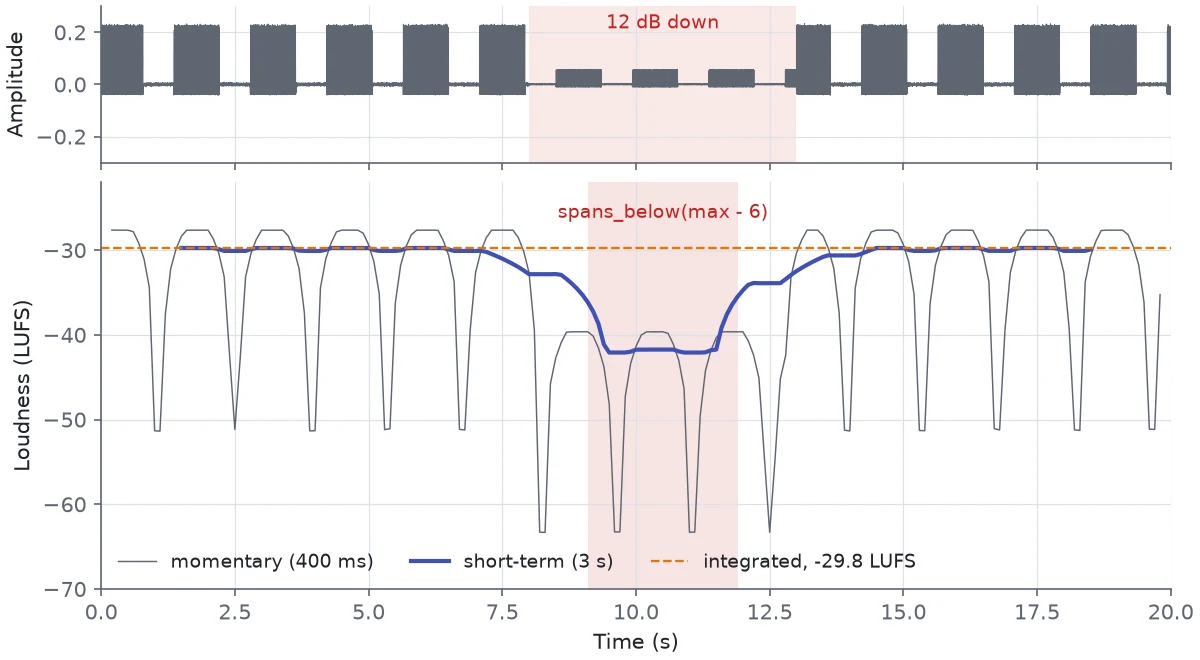
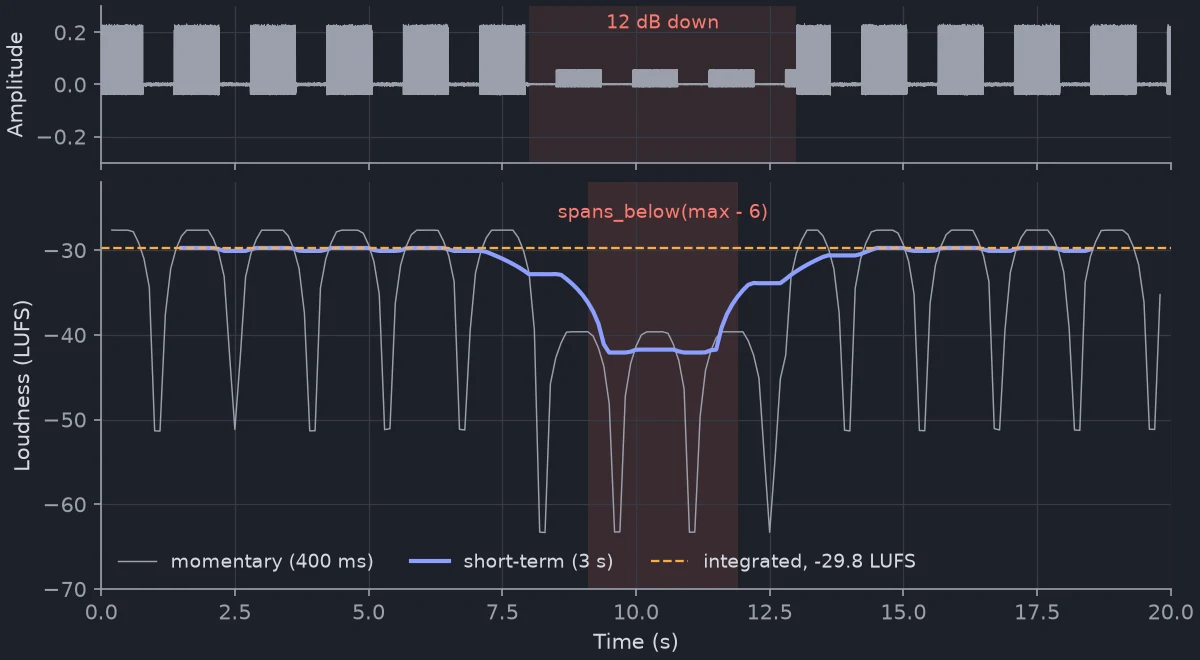
The window defaults to SHORT_TERM (3 s), which follows how loud a passage
is; MOMENTARY (400 ms) follows syllables.
Those are the two EBU Tech 3341 meters, and any other length in seconds works
too; all of them step by 100 ms (CURVE_HOP).
The short-term curve rides over the pauses but blurs the edges, placing a drop
that ran from 8 to 13 s at 9.1 to 11.9 s. The momentary curve dives into every
pause: on it, spans_below(max - 6) finds the drop and ten dips of 0.3 to
0.4 s, and min_seconds=0.5, longer than the dips, leaves only the drop, at
8.1 to 12.9 s. For a first look at a long take, and for
loudest() and
quietest(), the short-term
curve is the steadier one.
Two choices matter when you plot or search a curve. curve.times holds the
centre of each window, not its end as on a meter, so the first value of a 3 s
curve sits at 1.5 s, lined up with the audio that produced it. And the curve
is not gated, since holes where the gate fired would describe a recording that
stops existing between words. A window of digital silence reads -inf, which
quietest() skips and
spans_below() counts as
below.
Loudness range
loudness_range reduces the short-term
curve to one figure in LU, to EBU Tech 3342: its relative gate sits 20 LU below
the mean, not the 10 LU of the integrated figure, and it takes the spread from
the 10th to the 95th percentile, so a single door slam does not set it. 20 ms
at full scale in 20 s of a steady tone peaking at 0.3 moves it by 0.03 LU. A short-term curve
you already have gives
the same number as range_lu,
without measuring again:
print(f"{kudio.loudness_range(take, sr):.1f} LU")
print(f"{kudio.loudness_range(drift, sr):.1f} LU, {curve.range_lu:.1f} LU")
True peak
The largest sample is not the largest value the signal reaches. Samples are
points on a curve that passes between them, and a converter, a lossy encoder or
a resampler rebuilds that curve and clips where it overshoots.
true_peak measures the overshoot in dBTP, to
BS.1770-4 Annex 2, by oversampling. The textbook case is a full-scale sine at a
quarter of the sample rate, phased so that every sample lands on ±0.707:
n = np.arange(sr)
tone = np.sin(2 * np.pi * (sr / 4) * n / sr + np.pi / 4)
tricky = kudio.fade(tone, sr, 0.01, 0.01)
peak = 20 * np.log10(np.max(np.abs(tricky)))
print(f"samples {peak:.2f} dBFS, true peak {kudio.true_peak(tricky, sr):+.2f} dBTP")
The sine reaches 1.0 between the samples, 0 dBTP, and the meter lands within 0.02 dB of it. Without the 10 ms fades it reads +0.12 dBTP: a clip that starts and stops dead at 0.707 rings at both ends, and a converter playing it would ring the same way. The meter oversamples to at least 192 kHz, as the standard asks, which is 4x at 48 kHz and 12x at 16 kHz.
EBU R 128 allows a true peak of at most -1 dBTP. normalize_lufs warns only
about samples past full scale, so measure the true peak after normalising:
for target in (-23.0, -17.0):
    out = kudio.normalize_lufs(take, sr, lufs=target)
    sample = 20 * np.log10(np.max(np.abs(out)))
    print(f"{target:.0f} LUFS: samples {sample:+.2f} dBFS, "
          f"true peak {kudio.true_peak(out, sr):+.2f} dBTP")
-23 LUFS: samples -6.43 dBFS, true peak -6.14 dBTP
-17 LUFS: samples -0.43 dBFS, true peak -0.14 dBTP
At -17 LUFS every sample is below full scale, no warning is raised, and the take is still over the ceiling.
DNSMOS: what a listener would say
Whether a recording sounds good is a judgement, and with no reference and no
listening panel the only source of one is a model trained on a panel's
opinions. dnsmos runs DNSMOS, which predicts the
three ITU-T P.835 scores on the 1 to 5 MOS scale as a
DnsmosScore: SIG for the speech, BAK for
how unobtrusive the background is, OVRL overall. Under denoising SIG and BAK
move apart, since aggressive suppression eats the speech along with the
noise, and one number would hide that.
The weights belong to Microsoft's
DNS-Challenge and are distributed
there, and I would rather not bundle someone else's binary in a library that is
otherwise source only. So this needs two things the rest of the page does not:
pip install kudio[dnsmos] for onnxruntime, and a checkout of that repository.
score = kudio.dnsmos(take, sr, model_dir="DNS-Challenge/DNSMOS")
print(score.sig, score.bak, score.ovrl)
print(score.summary())
find_dnsmos_model looks in model_dir,
then in KUDIO_DNSMOS_DIR; either can name the file or a directory to search,
subfolders included. When a checkout holds more than one sig_bak_ovr.onnx,
the first in sorted path order wins, so point at the file when it matters
which one runs. Then:
- The audio is resampled to 16 kHz, the rate the model was trained at.
- It is cut into 9.01 s windows at a 1 s hop, the length the model expects,
and the windows' scores are averaged;
score.segmentssays over how many. The windows are laid out as in DNS-Challenge'sdnsmos_local.py, so a score here matches one published from that script: they start on whole seconds and end inside the clip's last whole second, so a 10.5 s clip gets one and a 20 s clip 11, with its last 0.99 s left out. The script itself scores only 7 of those 11: it works out each window's end in floating point, which rounds the windows starting at 7 to 23 s one sample short, and skips them. I keep them, so the two agree on any clip that stays under 17 s once doubled, and kudio scores more of a longer one. - A clip shorter than one window is doubled until it holds one, as that script does, rather than padded with zeros, and every window of the result is scored: a 2 s clip becomes 16 s and seven windows. Silence scores as ruined speech, and seven seconds of it after a two-second clip would report a problem the clip does not have.
- Each window's raw outputs go onto the MOS scale through
POLYFIT, the polynomials published for the non-personalised model, before the average is taken, the order DNS-Challenge'sdnsmos_local.pyuses. Apolyfit.jsonbeside the model replaces them, which any other model needs, andpolyfit=Falsekeeps the raw outputs.
summary() calls OVRL from 4.0 up
clean, from 3.0 usable, from 2.0 poor and below that bad. When SIG and BAK are
more than 0.7 apart it says which way: SIG 2.6, BAK 4.1 and OVRL 2.9 come out
as "poor (OVRL 2.90) — the background is cleaner than the speech, which is
what over-aggressive denoising looks like".
For a folder, open the model once and hand the session to every call. The
model directory is then never consulted, so a polyfit.json there is not read
either and the published coefficients apply:
from pathlib import Path

import onnxruntime as ort

model = kudio.find_dnsmos_model("DNS-Challenge/DNSMOS")
session = ort.InferenceSession(str(model), providers=["CPUExecutionProvider"])
for path in sorted(Path("corpus").rglob("*.wav")):
    try:
        y, sr = kudio.file_load(path)
        print(path.as_posix(), kudio.dnsmos(y, sr, session=session).summary())
    except (kudio.AudioIOError, kudio.FeatureError) as e:
        print(path.as_posix(), f"not measured: {e}")
From the command line
kudio info take.wav                        # header, encoding and peak
kudio report take.wav || echo "needs another take"
kudio loudness take.wav --target -23       # exit 1 when over 1 LU off
kudio report prints the report and its findings and exits 1 when there are
any. kudio loudness prints the integrated loudness, the range, the true peak
and the loudest and quietest moments; --over-time adds the curve, one line
per 100 ms. kudio report reads the file as mono, averaging the channels;
kudio loudness keeps them, since BS.1770 weights and sums the channels and
the mono mix of a stereo file reads 3 LU low. The flags are on Command line, and every parameter
of the functions here is in the API reference.