Synthesize
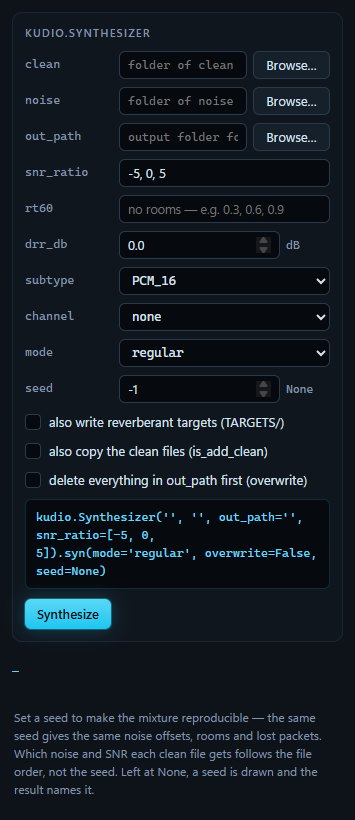
A denoiser learns from pairs: a noisy file and the clean one behind it. This
panel makes them. It mixes every clean file with noise at the SNRs you ask
for, can put the speech in a room first and send the mixture down a phone or
VoIP link after, and writes a manifest.json beside the result that records
what each file was made from. The line above Synthesize is the
kudio.Synthesizer call behind the run.
It works on folders and never touches the clip that is open. A run goes on in the background, so the window stays usable meanwhile, and the form is read once, when you press Synthesize: changing it halfway through changes nothing in the run.
What happens to each file
That is the order a microphone meets them in. The room acts on the speech before the noise is added, so the SNR is measured against the reverberant speech. The link comes last and carries the whole mixture, noise and all, because a wire carries whatever reached the microphone.
Folders
| Field | What it takes |
|---|---|
clean |
the folder of clean speech |
noise |
the folder of noise recordings |
out_path |
the folder the corpus is written to |
Type a path or use Browse…. Both input folders are read with all their
subfolders, and only WAV files count, .WAV included; a FLAC or MP3 in there
is left out. The output mirrors the clean folder's subfolders, so two talkers'
u0.wav stay two files.
Overwrite empties the folder
delete everything in out_path first (overwrite) is off by default, so the
call above Synthesize carries overwrite=False, and a folder that already
holds something is left exactly as it is. Nothing is written, and kudio's
reason is the status line and the second line of the result:
data\mixed is not empty, so nothing was synthesised. Pass overwrite=True to replace it, or point out_path= somewhere else.
Tick it to build a corpus again in the same folder. It is
syn(overwrite=True), and it acts on the folder rather than on single files:
if out_path holds anything at all, the whole folder is deleted before the
run starts, files that have nothing to do with the corpus included. I want a
corpus folder to hold exactly one run, so that the manifest beside it
describes every file in it, but deleting a folder is something to ask for,
not something that happens because a box was left as it came.
kudio will not empty a folder that is the root of a drive, or that holds the working directory, your home folder or any of the input files. The run stops instead, with the reason:
Synthesis failed — SynthesisError: refusing to empty data before synthesising:
it holds the input data\clean\spk1\u0.wav. Point out_path= at a folder of its own.
SNRs
snr_ratio takes the SNRs in dB, separated by commas or semicolons, and
starts at -5, 0, 5. Each value is an axis of the corpus. Fractions are fine,
and the file name spells them so that the extension stays the only dot in it:
| SNR | In the file name |
|---|---|
| 5 | _5dB |
| 0 | _0dB |
| 2.5 | _2p5dB |
| −5 | _n5 |
A fraction is never rounded off for a tidier name: 2.5 and 2.7 both written as
2 would be two outputs with one name, and one would overwrite the other. An
entry that is not a number stops the run before it starts, and the status bar
says Bad SNR list with the entry that failed.
Rooms
rt60 is empty by default, and empty means no room at all. Give it
reverberation times in seconds, 0.3, 0.8 say, and each becomes another axis:
every file the mode would write is written once per room, in either mode, so
two rooms double the corpus. The room shows in the name as _rt300ms.
Every output file gets a room of its own from kudio.rir, with the same RT60
and DRR and a tail drawn from the seed and the file's path. One room repeated
over a whole corpus is a single acoustic condition, and a model trained on it
learns that room.
drr_db, the direct-to-reverberant ratio, runs from −20 to +30 dB and is 0 by
default. It is distance in a readable unit: +10 and above is a close
microphone, 0 is a metre or two away, and negative is the far end of a hall.
It only does something when there are rooms.
Reverberant targets
The clean file is the dry target, so a model trained against it is asked to
remove the room as well as the noise. also write reverberant targets
(TARGETS/) writes the same speech with the room left on beside each mixture:
in TARGETS/ inside out_path, laid out like the mixtures and under the same
names. That is for training a model to remove the noise and leave the room, a
different and easier problem. The manifest records each one as the row's
target.
Targets need rt60. With no room the clean file already is that signal, and
the run does not start:
The link
channel sends every finished mixture down a link: the third kind of damage,
neither added like noise nor convolved like a room.
channel |
What it is |
|---|---|
none |
no link, the default |
telephone |
300–3400 Hz at 8 kHz, through G.711 μ-law |
telephone_a |
the same with A-law |
voip |
G.711 μ-law with 5% of the packets lost, in runs of 4 packets on average, each gap filled by repeating the last packet that arrived |
mu_law, a_law |
the companding alone, without the band limit |
A file comes back from the link at the length and sample rate it went in with.
The link is not an axis. A corpus is recorded over a phone line or it is not,
so one link holds for the whole run, and it goes into the manifest rather than
the file names. The packets voip drops are drawn per file from the seed.
Lost packets on the Effects page goes into what
loss, bursts and the repeat do to speech.
Regular or inc
mode |
Outputs | 200 clean files, 4 noises, 3 SNRs, 2 rooms |
|---|---|---|
regular |
one per clean file and room, the noises and SNRs taken in turn | 400 |
inc |
every clean × noise × SNR combination, in every room | 4800 |
regular is the one I use for training sets. Every clean file is used once
per room, and the noises and SNRs rotate over the clean files so that any 12
clean files in a row (4 noises × 3 SNRs) meet each combination exactly once. A
regular corpus with fewer clean files than there are combinations cannot hold
them all, and the coverage grid in the Manifest panel shows
which ones it lacks. inc writes the full product, which grows quickly, and
suits a test set where every condition should meet every talker.
Seed
seed at −1 shows as None, and a different seed is drawn every run. The
result line ends with the seed the run used, given or drawn, and after a draw
the status line names it too:
Type that number into seed and the same settings write the same corpus byte
for byte.
The seed decides where in each noise recording the crop starts, each file's
room, and the packets voip loses. Which noise and SNR go with which clean
file does not depend on it: that follows the order of the files.
Subtype
subtype is how the files are written: PCM_16, the default, PCM_24 or
FLOAT. A mixture is a sum, and a loud talker at a low SNR can land past full
scale. PCM_16 clips there, and so does PCM_24, with a finer step. The
status line then says how many files went over, and how far:
3 of 12 file(s) went past full scale and were clipped as PCM_16 (worst peak 1.30, +2.3 dBFS).
Lower the clean level, raise the SNR, or write subtype='FLOAT' to keep them.
FLOAT keeps the values past 1.0 instead of clipping them.
Copying the clean files
also copy the clean files (is_add_clean) copies each clean file into
RAW_DATA/ inside out_path, laid out like the clean folder and named
<name>_raw.wav, so the corpus folder carries its references along. Ticked,
it shows in the call as is_add_clean=True.
TARGETS/ and RAW_DATA/ both sit inside the output folder. Anything that
later collects every WAV under it collects those as well, the
Batch panel included, so a training script is better off reading
the corpus through its manifest.
What a run leaves
Three clean files in data/clean/spk1/, babble and fan in data/noise/,
three SNRs, two rooms, the telephone link and reverberant targets:
kudio.Synthesizer('data/clean', 'data/noise', out_path='data/mixed', snr_ratio=[-5, 0, 2.5], rt60=[0.3, 0.8], drr_db=0.0, channel='telephone', write_targets=True).syn(mode='regular', overwrite=False, seed=7)
data/mixed/
├── manifest.json
├── spk1/
│   ├── u0_babble_n5_rt300ms.wav
│   ├── u0_babble_n5_rt800ms.wav
│   ├── u1_fan_0dB_rt300ms.wav
│   ├── u1_fan_0dB_rt800ms.wav
│   ├── u2_babble_2p5dB_rt300ms.wav
│   └── u2_babble_2p5dB_rt800ms.wav
└── TARGETS/
    └── spk1/
        └── the same six names
The line under the form sums it up, and the status line says
Synthesis complete — 6 file(s).:
6 file(s) written to data/mixed · manifest.json beside them · down a telephone link · 6 reverberant target(s) in TARGETS/ · seed 7
The count is of files on disk, not of outputs asked for. Two outputs with one
name leave one file, and that happens when one clean file asks for the same
name twice: an RT60 typed twice, in either mode, or in an inc run an SNR
typed twice or two noise files of the same name in different subfolders. The
status line then gives both numbers and how many outputs shared a name, rather
than report a corpus that is not there.
Two different clean files never share a name that way. A clean a_b.wav with
noise c and a clean a.wav with noise b_c would both be
a_b_c_0dB.wav, so kudio gives the name to the first clean file that asks for
it and leaves the other out of the run and out of the manifest. Kept, it would
give the manifest a row pairing the mixture with a clean file it was not made
from, and a training script has no way to tell that row from a real one. The
warning under the line says how many clean files were left out and names the
first of them.
Whatever kudio warns about during a run is listed under that line, a warning a line: the clean files it left out, the outputs that shared a name, with one of them as an example, or an output folder it would not empty. Clipping is the exception, since the line and the status line already give it in full. When nothing was written, the warning is the status line; otherwise the status line says how many warnings there are, unless it is already about clipping or a shared name.
The manifest
manifest.json holds one record per mixture:
{
  "noisy": "data/mixed/spk1/u0_babble_n5_rt300ms.wav",
  "clean": "data/clean/spk1/u0.wav",
  "noise": "babble",
  "snr_db": -5,
  "rt60": 0.3,
  "channel": "telephone",
  "target": "data/mixed/TARGETS/spk1/u0_babble_n5_rt300ms.wav"
}
The room, the link and the target are in none of the file names, which is why
the panel writes this file. rt60, channel and target are null when the
run had none. Paths are spelled the way the run was given them, so relative
folders give relative paths, measured from the folder KudioStudio was started
in. A run that wrote nothing writes no manifest. The Manifest
panel reads it back as a table and checks every file in it against the disk.
While it runs
One synthesis runs at a time. From the moment a run starts, Synthesize is greyed out and reads Synthesizing… until the run is done. Quitting waits for the run to finish, as it does for a batch.